
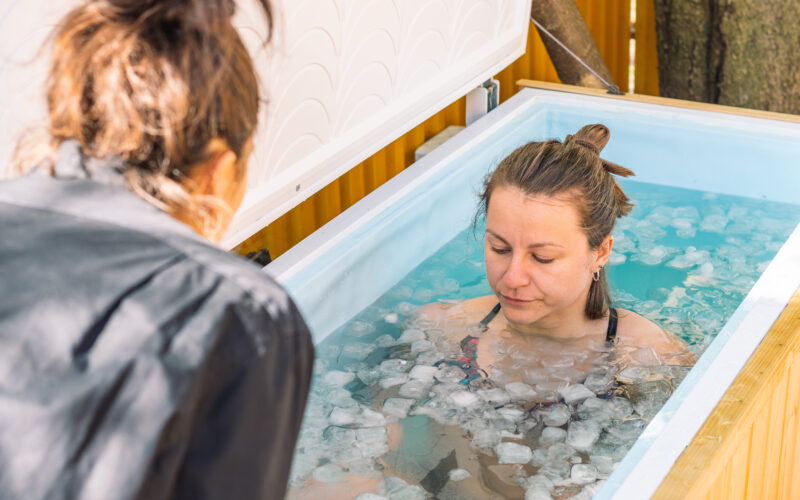
Since cold plunging started trending a few years ago, it’s become mainstream in the wellness world: videos tagged #coldplunge have garnered over a billion views on TikTok, and celebrities and health influencers advocate its benefits. Though I’ve never personally been interested in trying it, there is plenty of scientific evidence to back up claims that cold plunging can aid with everything from building resilience, to aiding muscle recovery, to boosting metabolism.
Recently, however, some people are questioning whether women—with their distinct physiology from men—actually benefit from sudden immersion in cold water the same way men do. For example, a recent article in SELF magazine addresses claims that cold plunges could actually be counterproductive for women. The article references a recent study with only female participants which found that cold plunging did not result in faster muscle repair [1].
So, is it worth it for women to take the plunge?
What is cold plunging?
Cold plunging, also known as cold water immersion (CWI), involves partially or totally submerging oneself in cold water for several minutes, either by sitting in a tub or jumping into a natural body of water.
Why do people do it?
The practice of cold plunging dates back to ancient times; records from both Egypt and Greece reference cold water for therapeutic and social uses. Today, there are two primary goals of cold plunging: general health and athletic performance [2].
Among elite athletes, the practice of using ice baths to aid in muscle recovery has been popular for decades. Many studies (and several meta-analyses) have gathered evidence that cold plunging after intense exercise helps to alleviate sore muscles, and—in some cases—aid in recovery [3] [4].
Around 2020, cold plunging became a viral wellness trend—and research has been promising in this area as well. One study found that cold plunging increased the amount of dopamine in the brain by 250%, indicating that it’s a powerful mood-booster [5]. Other research has shown that cold plunging has positive effects on metabolism and could improve insulin sensitivity [6].
What happens to the body during a cold plunge?
When either a man or woman’s body is immersed in cold water, the body’s immediate stress response is activated. Along with increased breathing and heart rate, there is a sudden spike in cortisol, dopamine, and adrenaline. Unlike chronic stress and consistently elevated cortisol levels, which contribute to inflammation and other health issues, the short-term stress response triggers an increase in white blood cell count and immune activation.
In response to the cold, blood vessels closer to the surface of the skin constrict—the body’s way of limiting blood flow to the extremities and keeping the core temperature stable.
Within minutes, the body starts to produce its own heat by shivering. It also activates brown fat tissue, which specifically works to maintain body temperature and also helps regulate blood sugar and insulin levels.
How do women’s bodies respond differently?
This process applies to both sexes; however, differences in women’s body composition mean that the effects of cold plunging can vary—and present added risks—for women.
Women feel cold temperatures more intensely than men due to their smaller size, lower muscle mass, and higher percentage of body fat. Being smaller means that women have a greater skin surface to volume ratio than men, allowing more heat to escape through the skin. Muscle helps to produce heat, especially when shivering, so men’s greater muscle mass helps them generate more heat more quickly.
Women tend to have slightly higher core temperatures than men, likely because their higher body fat provides more insulation. But women also tend to have colder hands, feet, and ears than men do, and one study found that women’s bodies started producing their own heat at a lower temperature than men’s—meaning that they didn’t just feel colder, they were colder.
These differences in the ways women react to cold temperatures mean that cold plunging causes greater discomfort for women, which can lead to an outsized stress response that ends up doing more harm than good. It also puts women at greater risk of developing hypothermia.
These differences in the ways women react to cold temperatures mean that cold plunging causes greater discomfort for women, which can lead to an outsized stress response that ends up doing more harm than good. It also puts women at greater risk of developing hypothermia.
How the menstrual cycle affects cold plunges for women
Not surprisingly, in a woman of childbearing age, the hormonal changes that her body constantly undergoes due to her menstrual cycles also affect her response to cold water immersion.
Women’s core temperatures are slightly warmer during the luteal phase than during any other part of the cycle. (That’s why a rise in basal body temperature is used as a biomarker in symptothermal fertility awareness methods to indicate that ovulation has occurred.) Progesterone (which is highest during the luteal phase) causes blood vessels in the skin to constrict, limiting blood flow to the extremities but raising the core temperature. Estrogen has the opposite effect; it causes blood vessels close to the skin’s surface to dilate, which in turn lets more heat escape. (It’s also responsible for that ‘ovulation glow’ that makes women appear more attractive around ovulation.)
According to Dr. Stacy Sims, an exercise physiologist and women’s health expert known for the tagline “Women are not small men,” women are more sensitive to cold stress and “experience greater drops in core temperature … in the luteal phase when progesterone is high.” The takeaway? Cold-plunging might be more stressful on the body during the luteal phase than at other points in the cycle—unless you tailor your plunge routine to your unique female physiology.
When it comes to women taking the plunge, research is ongoing
In addition to the added considerations around stress response and hormonal interaction, those who caution women against cold plunging point to the fact that the research around it has primarily been done on men.
However, more studies are being conducted that seek to understand how cold plunging might affect women’s health, including the study referenced by SELF [1]. While that particular study did not find any benefits for muscle recovery from cold plunging, a different study did find cold water immersion to be effective for reducing soreness and accelerating muscle repair in women. It’s worth noting that the two studies had different designs: both involved cold plunging after intense exercise, but the one that didn’t find any benefits measured the effects of a one-time cold water immersion, while the other looked at the effect of cold plunging over five consecutive days.
Danish scientist Dr. Susanna Søberg, who specializes in metabolism and cold and heat exposure, writes that more research is needed to understand how cold plunging interacts with women’s hormones, metabolism, and muscle repair process, but she sees the early evidence around cold plunging and women’s health as “promising.” According to Søberg, cold plunging can be an effective nervous system regulator, and there is some evidence that it may “support mitochondrial health, reduce inflammation, and aid fat oxidation in women.”
Dr. Stacy Sims has an excellent explainer on why women benefit most from cold plunging protocols at more moderate temperatures, and at shorter intervals, than those recommended for men. She also argues that it’s important to distinguish between cold plunging for health and performance, and to follow different protocols to actually derive the intended benefits.
Different goals, different methods
The primary factors that separate cold plunging for overall health and for athletic performance are temperature, frequency, and duration. Most of the adverse effects that women can experience from cold plunging result from temperatures that are too extreme. And cold plunging too often can cause the body to become used to it, lowering the release of cortisol and adrenaline, greatly reducing its effectiveness.
The primary factors that separate cold plunging for overall health and for athletic performance are temperature, frequency, and duration. Most of the adverse effects that women can experience from cold plunging result from temperatures that are too extreme. And cold plunging too often can cause the body to become used to it, lowering the release of cortisol and adrenaline, greatly reducing its effectiveness.
Dr. Sims makes the following recommendations for women to cold plunge safely and effectively:
Health: Moderately cold temperatures, around 57–59°F (14–15°C), will still activate the body’s short-term stress response and heat production by brown fat tissue. Dr. Sims recommends short immersions of two to five minutes, up to four times per week, to reap these benefits without overstressing the system.
Performance: For muscle recovery, slightly colder temperatures (50–54°F or 10-12°C) for up to 10 minutes can alleviate soreness and inflammation after an intense training session. Cold plunging after strength training is not recommended, as it can limit muscle growth.
When not to cold plunge
There is debate over the safety of cold plunging while pregnant [7]. Some scientists argue that cold plunging can be beneficial during pregnancy, reducing inflammation and potentially improving insulin sensitivity. The general recommendation, however, is to avoid cold plunging during pregnancy because of its potential to restrict blood flow to the developing baby and increase stress.
Because of the temporary strain on the heart and increased blood pressure that result from cold plunging, it’s also not recommended for those with heart problems or who are taking blood pressure medications. If in doubt, talk to your health care practitioner about the potential benefits and risks for you.
The bottom line: moderation is key
While there’s still plenty of research to be done on cold water immersion (especially for women), it seems that there are no major reasons why women should avoid taking the plunge—with a few precautions. For those who are interested in trying it, start slightly warmer (around 59°F or 15°C) for only a couple of minutes at a time. In the words of Dr. Søberg, cold plunging “isn’t about proving anything.” Start slow, and pay attention to how you feel (and if you’re a FAM user, how your cycles respond, and adjusting temperature and duration based on cycle phase) to determine whether you want to add cold plunging to your routine or whether it’s not for you.
References
[1] Wellauer V, Clijsen R, Bianchi G, Riggi E, Hohenauer E. No acceleration of recovery from exercise-induced muscle damage after cold or hot water immersion in women: A randomised controlled trial. PLoS One. 2025 May 7;20(5):e0322416. doi: 10.1371/journal.pone.0322416. PMID: 40333546; PMCID: PMC12057877.
[2] Allan R, Malone J, Alexander J, Vorajee S, Ihsan M, Gregson W, Kwiecien S, Mawhinney C. Cold for centuries: a brief history of cryotherapies to improve health, injury and post-exercise recovery. Eur J Appl Physiol. 2022 May;122(5):1153-1162. doi: 10.1007/s00421-022-04915-5. Epub 2022 Feb 23. PMID: 35195747; PMCID: PMC9012715.
[3] Xiao F, Kabachkova AV, Jiao L, Zhao H, Kapilevich LV. Effects of cold water immersion after exercise on fatigue recovery and exercise performance–meta analysis. Front Physiol. 2023 Jan 20;14:1006512. doi: 10.3389/fphys.2023.1006512. PMID: 36744038; PMCID: PMC9896520.
[4] Hohenauer E, et al. The effect of post-exercise cryotherapy on recovery characteristics: a systematic review and meta-analysis. PLoS ONE. 2015;10(9):e0139028. doi: 10.1371/journal.pone.0139028.
[5] Kelly JS, Bird E. Improved mood following a single immersion in cold water. Lifestyle Med. 2022;3:e53. https://doi.org/10.1002/lim2.53
[6] Huo C, Song Z, Yin J, Zhu Y, Miao X, Qian H, Wang J, Ye L, Zhou L. Effect of Acute Cold Exposure on Energy Metabolism and Activity of Brown Adipose Tissue in Humans: A Systematic Review and Meta-Analysis. Front Physiol. 2022 Jun 28;13:917084. doi: 10.3389/fphys.2022.917084. PMID: 35837014; PMCID: PMC9273773.
[7] Gundle L, Atkinson A. Pregnancy, cold water swimming and cortisol: The effect of cold water swimming on obstetric outcomes. Med Hypotheses. 2020 Nov;144:109977. doi: 10.1016/j.mehy.2020.109977. Epub 2020 Jun 11. PMID: 32570161.