


Creighton. Marquette. Couple to Couple League. These terms represent the modern evidence-based fertility awareness methods (FAM, also known as fertility awareness-based methods or FABM or natural family planning or NFP) with protocols specific to postpartum women.
Postpartum, particularly for breastfeeding women, is characterized by very different hormonal patterns (or lack thereof) compared to those of nonpregnant, naturally cycling women. As one example, cervical mucus observations don’t necessarily correlate to estrogen levels in breastfeeding women (more on this below). This is why postpartum-specific protocols are important for FAM users, and the top reason I was particularly excited to try out the Mira monitor to identify the return of my fertility after baby #5.
My experience using FAM during postpartum
First comes Creighton…
After babies 1, 2, and 3, I utilized the Creighton method to monitor my return of fertility. I opted not to use it after baby #4 because I experienced continuous mucus and difficulty distinguishing fertile from non-fertile mucus (yes, even though I worked with an instructor), which led to long, frustrating periods of confusion and, in retrospect, unnecessary abstinence.
Then comes Marquette…
After baby #4, we opted for sympto-hormonal fertility awareness monitoring via the Marquette Method, which utilizes the Clearblue fertility monitor. I had heard great things about Marquette, including from close friends. One major perk was the possibility of fewer days of abstinence when compared to other FAMs. Since low libido—caused or contributed to by a variety of factors characteristic to postpartum (including sleep deprivation and low hormone levels)—is often part and parcel of the postpartum experience, I wanted a method that offered the greatest range of available days for whenever I was, in fact, “in the mood.”
Expectation vs. reality
I was surprised and more than a little horrified when I experienced two straight months of HIGH readings (read: two straight months of abstinence) with the Clearblue fertility monitor. There’s a reason for this: when the Marquette Method was first developed, researchers reverse-engineered the Clearblue fertility monitor—which tests urinary hormone metabolites for the purpose of helping women conceive—for pregnancy prevention.
The clunkiness of the auto-readings of HIGH after one HIGH reading (until peak was detected OR the monitor was reset 10 days later, according to protocol) frustrated my husband and I, especially given our expectations when we began to use the method.
To add insult to injury, I did not have continuous mucus after the fourth baby (and have not since), and did have clear fertile-type mucus signs before my first ovulation. Yes, the Clearblue monitor did successfully identify the estrogen rise and LH peak, but my own mucus observations reflected the same thing.
…Then comes Mira with the baby carriage
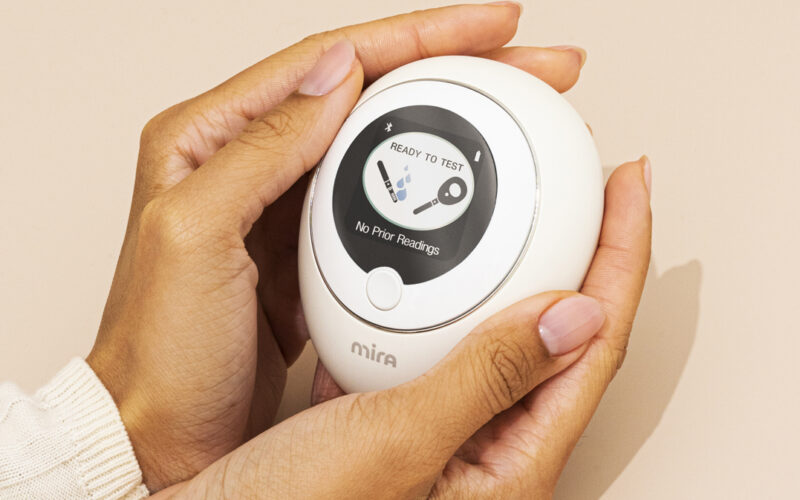
During my fourth postpartum, I’d heard about how Marquette Method leaders were beginning to research the use of the relatively new Mira monitor. Like Clearblue, Mira is a fertility monitor developed to help women conceive, not avoid pregnancy. However, a major advantage of Mira over Clearblue is its delivery of quantitative (think actual numbers) rather than qualitative (think LOW, HIGH, PEAK readings) urinary hormone level test results.
During my fourth postpartum, I’d heard about how Marquette Method leaders were beginning to research the use of the relatively new Mira monitor. Like Clearblue, Mira is a fertility monitor developed to help women conceive, not avoid pregnancy. However, a major advantage of Mira over Clearblue is its delivery of quantitative (think actual numbers) rather than qualitative (think LOW, HIGH, PEAK readings) urinary hormone level test results.
That’s why, when I was three months postpartum with baby #5 and anticipating using a fertility awareness method around four months (I chose that rough timeframe because I was exclusively breastfeeding and my cycle has come back later and later with each baby), I reached out to Mira. I asked to test their product specifically to monitor return of fertility, with the intention to write it up for Natural Womanhood and my postpartum podcast.
Mira obliged, and in exchange for a fair and honest review, I received a monitor and one pack of their Ultra wands, which test for estrogen (E3G), progesterone (PdG), LH, and FSH. After that first month, I purchased Plus wands that test E3G and LH only, and then, most recently, Max wands that test E3G, PdG, and LH. The fewer hormones tested, the cheaper the wand.
Similarities between Mira and Clearblue
In some ways, monitoring my return of fertility using the Mira monitor is comparable to using the Clearblue monitor. There are guidelines around the collection of the urine sample, including testing the first urine of the day, plus how long you have to run the test after taking the sample (maybe that sounds funny, but in real life, sometimes you wake up and collect the sample but don’t test right away).
Mira is different in that you can test any time of day, rather than during a set six-hour window every day as with Clearblue, and you can test as many times per day as you want (more on this below). Whereas Clearblue requires you to set up “fake” cycles to trigger a specific testing schedule, Mira does not. Additionally, Clearblue users trying out Mira will have to adjust to inserting the wand without hearing the “click” they’re used to. With Mira, you insert, pause for a second or two, and then you’ll hear the click. I include this note because I wasted a wand by “jamming” it in until I heard the click.
The Mira app was easy to use, but not set up for postpartum hormone monitoring
I also appreciated the effortless synchronicity between “the egg,” as the small white testing machine is nicknamed, and the app, plus the auto-generated graphs of each tested hormone.
One drawback I noted was that while I could “tell” the app that I was a) breastfeeding and b) not cycling, I was unable to specify that I was monitoring the return of my cycle. This difficulty was partially resolved by the newly-developed NFP/FABM setting option, which removes all cycle-related predictions about ovulation and period timing. While Mira wasn’t designed for pregnancy prevention, I appreciate this clear investment in the NFP/FAM community.
One drawback I noted was that while I could “tell” the app that I was a) breastfeeding and b) not cycling, I was unable to specify that I was monitoring the return of my cycle. This difficulty was partially resolved by the newly-developed NFP/FABM setting option, which removes all cycle-related predictions about ovulation and period timing.
Excellent customer service experience
After I purchased four boxes to take advantage of a small discount for buying in bulk, I had my first meeting with my Marquette Method (MM) instructor, and learned about a significant discount I could have taken advantage of as a MM user. (I already had a machine, as noted above, but learned that this discount applies to machines as well.) Whereas Mira wands previously cost me several dollars per wand (more hormones tested equals higher cost, so Ultra wands are pricier than Plus wands), the discount would have brought their cost more in line with Clearblue wands.
I reached out to Mira on the off chance that they would somehow honor the higher discount, and they responded in the most satisfactory way possible. They issued me a gift card for the difference between what I spent and what I would have spent if I’d used the MM user discount.
Beginning postpartum hormone monitoring in earnest
With each successive baby, my cycle has returned about one and a half months later each time. After baby #4, it came back at 7.5 months postpartum. This time around, I estimated I might ovulate for the first time again around 8.5 or 9 months postpartum. I was surprised, then, when at just over 7 months postpartum, I observed what looked like fertile-type cervical mucus. It was time to take testing seriously.
Making sense of the different wands—and their results
Now, something curious happened when I switched wand types, from the more expensive Ultra (FSH, LH, E3G, PdG), to the cheaper Plus (LH, E3G) type. That very first day, my LH levels remained essentially unchanged from the day before, but my E3G read 40 points lower. In other words, the absolute E3G number obtained was lower on one wand type than the other.
As I continued to use the Plus wands, my average E3G level consistently read 40-50 points lower than the average daily Ultra wand results had read. In contrast, my LH readings read similarly across both Plus and Ultra wands.
Catching the return of my fertility… sort of
You might be wondering, why did the discrepancy between wand readings matter? In Marquette’s soft protocols for Mira use during postpartum (meaning that the recommendation is provisional and research is ongoing), users should count themselves as potentially fertile for any E3G level over 100. While my E3G levels using the Plus wands did show a clear rise—approximately 30 points above baseline—they did not exceed 100 until my peak day.
Translation: If I’d ignored my mucus observations and continued having intercourse until my estrogen reached 100, we could conceivably (pardon the pun) be several weeks into a pregnancy by now! I was especially concerned because our last two babies were conceived 6 full days before peak day during my first six cycles after return of fertility (the first time, baby was 11 months old and my mucus signs had been confusing; the second time, baby was 13 months old and we’d been ‘trying to whatever,’ or not actively avoiding pregnancy). Would this be our third “peak -6” baby?
When I reached out to my Marquette instructor, she recommended I confirm ovulation by using a different type of wand—the Max wands, which test LH, E3G, and PdG (progesterone). A confirmed rise and sustained elevation in progesterone following the peak day would presumptively confirm ovulation had occurred.
Seeking clarity
Spoiler: the Max wands arrived the morning of the eighth day after ovulation (according to the LH surge as monitored by the Plus wand)… and my first postpartum period started that night.
I was perplexed.
I’d talked up the Mira monitor to family, friends and podcast listeners alike, emphasizing how research (albeit small trials, which is not unusual for an emerging technology) had proven the Mira monitor to be as effective in determining the fertile window as the Clearblue fertility monitor and serum blood draws. But what was I to make of the discrepancy between readings across the different types of wands—especially since I never even reached the 100 E3G benchmark reading?
When I reached out to my contact at Mira, she confirmed that 40-50 point variance from one wand type to the next was considered ‘within normal limits.’ Additionally, my MM instructor said we could lower my threshold of presumed fertility from 100 to 75 to better “catch” my fertile window the next cycle.
But with a 30-40 point variance from one type of wand to the next, an E3G of 50 (presumed infertility) with the Plus wand could be 80 (possible fertility) with the Ultra wand. I’d used Max wands for every test after my period started, and the results were in line with Ultra results. I was confused about how to proceed: should I trust the Max and Ultra wands, or the Plus wands?
Next steps
My next step was a conversation with Mira’s Clinical Manager, Rose MacKenzie, who educates healthcare professionals—including OB/GYNs, nutritionists, health coaches, acupuncturist, functional medicine providers, and NFP/FABM instructors—on how to use hormone tracking to improve patient outcomes.
Rose is a Registered Nurse trained in the Couple to Couple League symptothermal method, a certified Marquette Method instructor, and is also familiar with the Creighton Model.
Mira is a tool—not a method
In a wide-ranging, hour-and-a-half-long conversation, MacKenzie answered questions and addressed misconceptions. She stressed that Mira is a tool for monitoring fertility, not an NFP/FAM method in and of itself.
Specifically, Mira is one option for monitoring both estrogen and LH as part of the Marquette Method. Other estrogen monitoring options for Marquette users include cervical mucus monitoring (though, for postpartum breastfeeding women awaiting return of fertility, Marquette researcher, Dr. Thomas Bouchard’s previous research found that cervical mucus observations only correlated with estrogen levels 35% of the time; similarly, in their first six cycles after return of fertility, mucus observations correlated with urine levels 33% of the time) and the Clearblue monitor. Other LH testing options include LH test strips or the Clearblue monitor.
The key takeaway from all this is that no matter what tool is used, working with a trained instructor remains imperative. This is particularly the case because an algorithm or protocol, not Mira test results, still dictates the window of abstinence for the first 6 cycles after return of fertility for breastfeeding women. This is specifically because we don’t always get six full days of estrogen rise before ovulation postpartum, even though six full days of abstinence prior to ovulation are necessary to reliably avoid pregnancy.
The key takeaway from all this is that no matter what tool is used, working with a trained instructor remains imperative. This is particularly the case because an algorithm or protocol, not Mira test results, still dictates the window of abstinence for the first 6 cycles after return of fertility for breastfeeding women.
Don’t look to monitors to give you more ‘available days’
MacKenzie explained that the monitor results could tell us that abstinence should start sooner than the protocol dictates, but it will not give additional ‘free’ days (i.e., extra available days for intercourse) for breastfeeding women during the follicular phase of their first six cycles—assuming, of course, that the woman is trying not to get pregnant.
MacKenzie also told me that research on the Mira monitor (much of which is in-process) increasingly suggests that a change from the user’s personalized baseline, not an absolute number value, is most important for determining fertility. A change of, say, 30 or 40 points from one’s baseline could help identify the opening of the fertile window, rather than a cut-off value of 100. (In fact, there’s some similarity with blood pressure readings. While anything from 90/50 to 120/80 is considered normal, each person’s baseline will be different and a change from their normal can be observed.)
In line with this reasoning, using the same type of test sticks for each follicular phase to monitor E3G changes is recommended. Although there are normal ranges for hormones, each person’s hormone levels are different. It’s more important to focus on trends and patterns than on one single data point or one absolute number.
Postpartum hormone monitoring is very different from hormone monitoring of regular cycles
Before our conversation, I understood in general that postpartum hormone patterns can be unpredictable, but MacKenzie helped clarify some important specifics. During the postpartum period, estrogen can fluctuate without leading to ovulation. It’s also possible to experience an LH surge without ovulation, or to see a noticeable rise in estrogen that still does not result in ovulation. I was fascinated to also learn (see peak-6 babies above!) that ovulation can occur while estrogen is still rising, not just after it has peaked.
Using the Mira monitor to track E3G, LH, and PdG can help distinguish which E3G and LH rises actually lead to ovulation, as confirmed by a sustained rise in PdG—but this will only confirm ovulation in retrospect, not predict it.
Postpartum cycles are characterized by weak estrogen rises, long follicular phases, and short luteal phases
MacKenzie also noted that although my E3G levels did not rise above the standard threshold of 100, lowering the threshold to 75 in my case may have been more appropriate. That said, my overall hormone pattern was fairly typical for postpartum: relatively “weaker” E3G rises followed by a short luteal phase, which would not be supportive of pregnancy.
In fact, a small 2025 study found that postpartum cycles tend to have longer follicular phases and shorter luteal phases than regular cycles. In the study, postpartum women and regularly cycling women had relatively similar E3G levels throughout the cycle, but postpartum women had much higher LH surges. Breastfeeding appears to make the ovaries less sensitive to LH’s impacts, meaning that an estrogen rise may not trigger an LH surge, and/or, as this small 2023 study found, LH may have to surge much more in postpartum cycles than in regular cycles in order to trigger ovulation.
Breastfeeding appears to make the ovaries less sensitive to LH’s impacts, meaning that an estrogen rise may not trigger an LH surge, and/or, as this small 2023 study found, LH may have to surge much more in postpartum cycles than in regular cycles in order to trigger ovulation.
Taken together, Marquette Method researchers recognized from the 2023 and 2025 studies plus others that the estrogen threshold (which they’d previously believed to be 150) needed to be lower (now it is considered 100, with exceptions to lower it further, as in my case) and the LH cutoff could be even higher. My Marquette instructor and MacKenzie also noted that my threshold of 75 may rise with future cycles, as hormone levels tend to rise with subsequent cycles and as the mother weans.
As with so many areas in women’s health, more research is needed, as the 2023 study researchers alluded to the importance of “understanding that this is only a pilot study in preparation for larger effectiveness studies using quantitative monitors in the postpartum return of fertility.”
The bottom line on utilizing the Mira monitor for postpartum fertility awareness
Following my conversation with MacKenzie, I’m more comfortable in utilizing the Mira monitor as part of the Marquette Method for pregnancy prevention. I recognize more fully why postpartum can be a tricky time for determining fertility even with objective results from a machine.
More than ever, I understand why Mira should not be used for standalone DIY pregnancy prevention. As with every other fertility awareness method, working with a trained instructor is not optional but imperative. And, as the common refrain runs here at Natural Womanhood, I look forward to further research, to shed additional light on postpartum generally and postpartum hormone monitoring specifically.


With over 850,000 assays of women’s cycles, the Billings Ovulation Method is an excellent choice for postpartum/breastfeeding. The method has objective criteria for recognition of the Basic Infertile Pattern so couples can be confident in using the 4 simple rules. No gadgets or testing strips are required. A Certified Teacher consult assures accuracy in charting and accompaniment with the return to fertility.
Always is interesting to read the report of an experience, in this last case the return of fertility in postpartum by Anne Mary Williams. I am disappointed on the ignorance about LAM (Lactational Amenorrhea Method) by the consulted teachers on NFP and which causes pointless of cervical mucus secretion, and difficulties with the return of genital contacts.
The lactational amenorrhea method (LAM) requires 3 conditions.
All 3 must be met:
1. The mother’s monthly bleeding has not returned.
2. The baby is fully or nearly fully breastfed and is fed often, day and night.
3. The baby is less than 6 months old.
By those conditions the possibility of unplanned chance of pregnancy is between1-2%, without any restriction of intercourse.
“Seven study centers participated in this research. They were located in Chengdu, China; Guatemala City, Guatemala; Melbourne/Sydney, Australia; New Delhi, India; Sagamu, Nigeria; Santiago, Chile; and Uppsala, Sweden. A total of 4,118 women were recruited into the study between April 1989 and the last completed in December 1993.1 “Mothers were instructed to fill in a card on which they recorded the daily number of breast-feeding episodes and manual breast expressions, the number and type of any supplementary feeds, and vaginal bleeding and spotting (separately). Any episodes of illness of either the mother or the infant, together with any medications used, also were recorded for 24 hours. Every 2 weeks, mothers were visited at home every 2 weeks…”2, 3,4. As you see it is not necessary to register cervical mucus secretion, only breastfeeding, amenorrhea and age of the baby.
A bleeding during the first 56 days is lochia, no return of menses.
They recommended un maxim interval of suckling as 4 hours daytime breast-feeds and 6 h. nighttime.
The return of fertility after the end of LAM by Sympto-Thermal Method is studied and published, between other, by communication@serenaquebec.com or Ottawa.
At the end of LAM, Mira monitor can also be interesting.
REFERENCES
1. The World Health Organization Multinational Study of Breast-feeding and Lactational Amenorrhea. I. Description of infant feeding patterns and of the return of menses Fertility and Sterility 1998 vol. 70, no. 3, 448-460.
2. The World Health Organization Multinational Study of Breast-feeding and Lactational Amenorrhea. IV. Postpartum bleeding and lochia in breast-feeding women. Fertility and Sterility 1999 vol. 72, no. 3, 441-447.
3. https://fphandbook.org chapter-20 (2022)
4. https://www.cdc.gov › hcp › usmec Appendix G: Lactational Amenorrhea Method | Contraception Centers for Disease Control and Prevention | CDC (.gov) Sep 26, 2025
I am sorry of the ignorance of Lactational Amenorrhea Method, (LAM) requires 3 conditions.
All 3 must be met:
1. The mother’s monthly bleeding has not returned.
2. The baby is fully or nearly fully breastfed and is fed often, day and night.
3. The baby is less than 6 months old.
The possibility of unplanned chance of pregnancy is between 1-2%, without any restriction of intercourse.
They recommended un maxim interval of suckling as 4 hours daytime breast-feeds and 6 h. nighttime.
A bleeding during the first 56 days is lochia, no return of menses.
The prospective study was international on 4,118 mothers and promoted by World Organization Health. It was published more than 3 decades ago.
Thanks for your comment, Francoise, and I appreciate the opportunity to clarify. I did not meet LAM criteria because my baby slept 6+ hour stretches by about 10 weeks old. Additionally, while anecdotal evidence, my sister is among the 1-2% ineffectiveness for LAM. Her period, not lochia, has returned between 4 and 8 weeks after each of her 3 babies. Periods that early likely would not support a pregnancy due to short luteal phases, but–while reliable for the vast majority of women–LAM would not be effective for her.
Thank Anne Mary for your clarification. For yourself, it is possible to breastfeed a sleeping baby at the 6 hours, the mother uses an alarm o clock and she puts the baby at her breast and he sucks sleeping, with the consequence on infertility for the couple.
I have another question about your continuous and unclassified mucus secretion (you are not alone with this problem). Had you a little light in your bedroom? The questionnaire is very detailed, so I send it to Grace. This little light can produce alterations of the menstrual cycle (very short o very large, unclear mucus, spotting, short CL, subfertility…): the solution is darkness. During breast-feeding, another option is breast-fed with a smaller interval, more frequently. This little light can produce spotting during breastfeeding.
For your sister: the studies about LAM describe that lochia can stop and return during the 56 postpartum days (8 weeks) include if the mother is thinking in a menstruation for the abundance of the bleeding. Perhaps LAM would have been effective for her. It is necessary to read entirely all the publications about LAM, not only the abstracts. It should be interesting to know when a real menstruation occurs (with previous mucus secretion, peak day and high temperatures) and your sister observed after her “first” period. Cases are mentioned in LAM’s studies and other by SERENA… The 1-2% ineffectiveness for LAM indicates the conception rate.
If my text has mistaken, sorry, English is for me the 4th language.
Anne Marie! This was a GREAT read!! Well-written. Thank you!
Excellent review. I learned a lot from this alone and it puts Marquette & Mira into better perspective, along with the importance of an instructor who has up to date protocols. Thank you for your thorough analysis.