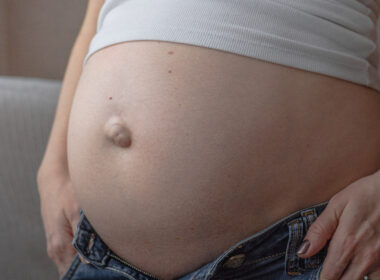


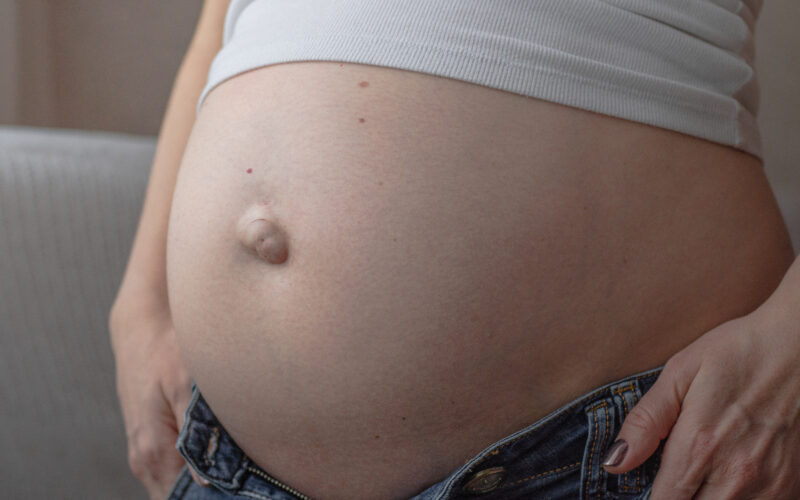
Those of us who have carried babies to term know that after birth, your body does anything but “snap back.” I would regularly look at my belly button quizzically—how did two pregnancies make my belly button go from an “innie” to a half-“outie”? It wasn’t until I finally asked my OBGYN what caused it that I realized I had not one but two hernias—not just my new, weird belly button, but also what I had previously assumed was just C-section scar tissue from my first birth.
I was shocked. I was under the assumption that only men got hernias from lifting very heavy things, but apparently, hernias are also very common in women who have been pregnant and given birth (whether vaginally or via C-section).
What are hernias?
A hernia happens when part of an internal organ pushes through a weak spot or opening in the surrounding muscle, most commonly in the abdomen or groin area. There are quite a few types of hernias, but Cleveland Clinic cites these as the most common:
- Inguinal hernia: the most common type of hernia, though these usually happen in men (about 25% of all men will experience one), these consist in a part of the bowel that protrudes through the inner thigh
- Hiatal hernia: another common type of hernia (about 20% of all people will experience one—50% of people over the age of 50) where the stomach can push its way through an opening in the diaphragm and protrude in the chest
- Incisional hernia: when tissue (usually the small intestine) protrudes though an old incision in the abdominal wall that’s been weakened from surgery
- Umbilical hernia: part of the intestine pokes through the abdominal wall around your belly button
We’ll be focusing on the last two, though the inguinal and hiatal hernias are good to be aware of since they are the two most common hernias in the general population (and know that both hiatal and inguinal hernias may also develop during pregnancy).
Umbilical hernias
Umbilical hernias, also called navel hernias, are the most common type of hernia found in women. Statistically, only about 0.08% of women get umbilical hernias during pregnancy (though I would wager that statistic is underestimating the amount of women not seeking medical attention for asymptomatic hernias) [4].
When umbilical hernias happen in adults, it’s typically when the intra-abdominal pressure (the pressure pushing from the inside-out) from pregnancy, obesity, excess fluid collection in the abdomen, or large tumors increase past the point where the already weakened muscles around the belly button are, and either fat or part of the intestines pushes out and past the navel [3].
Though people usually associate the word “umbilical” with a baby in-utero’s umbilical cord tying them to the placenta attached to their mother, in this instance umbilical is referring to the woman’s own belly button. Before birth, the umbilical cord and placenta are the lifelines of the baby. Containing two arteries and one vein, the umbilical cord and placenta bring oxygenated blood from mother to baby, clean baby’s blood and exchange waste products (before baby can produce their own urine), pass glucose, nutrients, and antibodies from the mother to baby, and make hormones that support baby’s growth and development.
Once the baby is born, the abdominal muscles should eventually close around where the umbilical cord used to be, leaving a belly button. Fun fact, an “outie” belly button can actually be an umbilical hernia from the abdominal wall closing all the way!
Incisional hernias
A well-documented complication after any kind of abdominal surgery, incisional hernias can also be linked to C-sections. Though they occur at low rates, they can even develop many years after the initial abdominal surgery.
Similarly to umbilical hernias, the most common symptom of incisional hernias are a bulge near the surgical incision site ranging in size from very small and only detectable by feeling the affected area, to the size of a basketball. These are also caused by intra-abdominal pressure pushing outward against the weakened abdominal muscles around the incision site, leading to the intestines pushing through the muscle layer.
What are your chances of developing a hernia after pregnancy and childbirth?
While the risk of developing a hernia during pregnancy are slim, there are several factors that may predispose a woman to them:
- Expecting more than one baby
- Obesity during pregnancy
- History of hernias
- Prior pregnancies
- Straining during bowel movement or labor
- Already weak abdominal muscles prior to pregnancy
- Heavy lifting during pregnancy
- Exercising too intensely and too soon postpartum
That covers quite a wide spectrum of people, I know! But once again, it comes down to the intra-abdominal pressure being placed on your abdominal muscles. Women carrying one child already experience “a state of chronically increased intra‐abdominal pressure caused by a growing fetus, fluid, and tissue.” [4] The more babies a woman is carrying in-utero, the greater the internal pressure.
C-sections, in particular, seem to increase the risk of incisional hernias
As far as incisional hernias go, it seems as though multiple C-sections increases the risk dramatically. One Australian study published in The Australian and New Zealand Journal of Obstetrics and Gynecology followed 642,578 women who had given birth between the years 2000-2011. Researchers found that 217,555 of those women (33.9%) had at least one C-section, and 1,554 of them (0.2%) had a subsequent incisional hernia repair. In fact, after the researchers controlled for possible mitigating factors (such as the duration of follow-up and known explanatory variables, like other abdominal surgery, parity and multiple pregnancy), they found that women who had given birth via C-section were nearly three times as likely to require a later incisional hernia repair than women who had given birth vaginally. Women with multiple C-sections had an even higher risk of needing an incisional hernia repair: mothers with two C-sections had a three times higher risk than women with no history of C-section, and women with five C-sections had a six times higher risk [5].
Having weaker muscles before pregnancy—whether due to obesity, previous pregnancies without having recovered muscular tone and strength between pregnancies, having a history of hernias, or not having strong abs to begin with, means lots of pressure pushing outwards on weak muscles, increasing the risk of a hernia.
Conversely, lifting too heavily during pregnancy (especially using the valsalva maneuver commonly used in strength training) or lifting too heavily too soon postpartum, no matter how strong your abs were pre-pregnancy, can very easily result in a hernia—unfortunately, I can attest to this. As soon as I told my husband I had two hernias from my first pregnancy, we both knew this was the reason why. Just because you trained like Superwoman before pregnancy doesn’t mean you should lift like her while you’re pregnant.
Is surgical repair of hernias always necessary?
Of course this needs to be a conversation between you and your doctor, but while many hernias from the pregnancy and postpartum period are relatively asymptomatic, there are definitely some red flags of which to be aware.
Strangulated or incarcerated hernias are very serious. This happens when the part of the intestine that is protruding starts to get trapped within the abdominal wall, cutting the blood supply off and slowly leading to tissue death of that portion of the intestine. Symptoms of this include:
- Slowly intensifying pain in the abdominal area
- Tenderness or pain near the hernia
- Nausea or vomiting
- Redness and swelling of the hernia
Strangulated or incarcerated hernias are very serious. This happens when the part of the intestine that is protruding starts to get trapped within the abdominal wall, cutting the blood supply off and slowly leading to tissue death of that portion of the intestine.
This, of course, needs immediate medical attention. About 65% of adults with an umbilical hernia will eventually get surgery to repair the injury; luckily only about 4% of which are emergency surgeries [1]. According to the University of Michigan School of Medicine, most surgeries are repaired laparoscopically, where several small incisions are made around the affected area, and robotic arms and cameras are inserted to make the repair, usually with a mesh patch to keep the intestines from poking out again. For the smaller hernias, a small incision is made and the muscle wall is stitched closed.
Luckily, asymptomatic hernias are able to be carefully managed without a surgical repair. For women interested in getting pregnant again, your doctor may advise you to hold off on surgery until you’ve stopped having children.
Luckily, asymptomatic hernias are able to be carefully managed without a surgical repair. For women interested in getting pregnant again, your doctor may advise you to hold off on surgery until you’ve stopped having children.
The big picture
Getting a hernia during pregnancy or in the postpartum period is rarely something in your own control as long as you’re looking after your body. Maintain a healthy body weight, but also don’t exercise so aggressively that you’re placing too much inter-abdominal pressure on the fragile muscles around your belly button or on past C-section scars to pop a hernia.
If you do end up with a hernia after your pregnancy, keep an eye on it, let your doctor know of any changes, and consider getting surgery if you don’t anticipate any future pregnancies.
References
- Holt AC, Bamarni S, Leslie SW. Umbilical Hernia. [Updated 2024 Feb 27]. In: StatPearls [Internet]. Treasure Island (FL): StatPearls Publishing; 2025 Jan-. Available from: https://www.ncbi.nlm.nih.gov/books/NBK459312/
- Kulacoglu H. (2018). Umbilical Hernia Repair and Pregnancy: Before, during, after…. Frontiers in surgery, 5, 1. https://doi.org/10.3389/fsurg.2018.00001
- Maia, R. A., Salgaonkar, H. P., Lomanto, D., & Loo, L. (2019, April 10). Umbilical hernia: When and how. Annals of Laparoscopic and Endoscopic Surgery. https://ales.amegroups.org/article/view/5123
- The association between maternal intra-abdominal pressure and hypertension in pregnancy Jayasundara S, Goonewardene M, Dassanayake L (2023) The association between maternal intra-abdominal pressure and hypertension in pregnancy. PLOS ONE 18(10): e0284230. https://doi.org/10.1371/journal.pone.0284230
- Shand, A. W., Chen, J. S., Schnitzler, M., & Roberts, C. L. (2015). Incisional hernia repair after caesarean section: a population-based study. The Australian & New Zealand journal of obstetrics & gynaecology, 55(2), 170–175. https://doi.org/10.1111/ajo.12270