


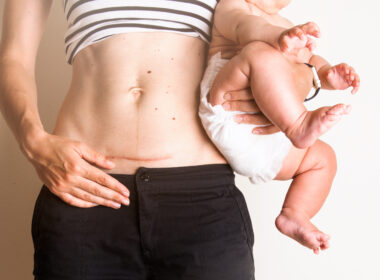

One in 3 babies in the U.S. are born via C-section. Despite their prevalence, C-sections are still major abdominal surgeries, with attendant risks. If you’ve had a C-section in the past and are struggling to conceive now, it’s possible your scar could be playing a role. Here’s what to know about the connection between uterine isthmocele, aka C-section surgical scar defect or Cesarean scar defect, and secondary infertility.
What is a uterine isthmocele and why do they form?
A C-section requires cutting through or separating a whopping seven layers of tissue. Once the surgeon is down to the uterus—the pear-shaped muscle that grows exponentially over the course of pregnancy to hold the baby inside his or her amniotic sac—he or she must cut through the uterine muscle wall to access the amniotic sac. After the baby is removed, the uterus is sewed back together with either one or two layers of sutures.
But sometimes, the three standard stages of wound healing (beginning immediately after C-section surgery and formally concluding a year or two later), don’t occur properly for the incision in the uterine muscle wall [1]. The end result can be a too-thin muscle layer.
In a 2025 Instagram reel, St. Louis-based restorative reproductive medicine (RRM)-trained OB/GYN, Dr. Gavin Puthoff, summed up: “A uterine isthmocele is a small pouch or defect in the wall of the uterus where the muscle simply didn’t heal after your C-section.” Infection may be a main reason uterine isthmocele form [2].
How often do C-section scar defects occur?
As C-sections are on the rise here in the U.S. and globally, so are Cesarean scar defects. Uterine isthmocele is almost shockingly common, occurring in as many as 2 of 3 C-section cases [2] [3]. In up to 30% of these women, Cesarean scar defect can cause abnormal vaginal bleeding separate from menstrual period bleeding, painful periods, pelvic pain, and/or secondary infertility.
How can a Cesarean scar defect impact future fertility?
The connection between uterine isthmocele and secondary infertility (infertility after successfully carrying one or more pregnancies) is fairly straightforward. Dr. Puthoff explained, “[The isthmocele] area can trap blood, which causes inflammation that leads to infertility and miscarriages.” Fluid can also accumulate along with the blood, worsening inflammation.
This YouTube video by Texas-based double board-certified OB/GYN and reproductive endocrinologist Dr. Natalie Crawford breaks down several research studies on rates of secondary infertility for women who previously gave birth vaginally versus via C-section. In general, women were about twice as likely to experience secondary infertility after one or more previous C-sections compared to women who had only ever given birth vaginally.
Crawford further specified that secondary infertility after C-section may be caused by one or more of five different factors (of which uterine isthmocele is one). The four other factors could include: 1) previous birth trauma leading to delaying future pregnancy; 2) factors such as age or underlying fertility issues leading women to undergo IVF or other ART procedures (C-section rates are higher in women who are older and/or have had IVF); 3) previous C-section that healed normally but still contributed to future placenta implantation issues for unknown reasons; and 4) scarring of the uterus.
Secondary infertility after C-section may be caused by one or more of five different factors (of which uterine isthmocele is one). The four other factors could include: 1) previous birth trauma leading to delaying future pregnancy; 2) factors such as age or underlying fertility issues leading women to undergo IVF or other ART procedures (C-section rates are higher in women who are older and/or have had IVF); 3) previous C-section that healed normally but still contributed to future placenta implantation issues for unknown reasons; and 4) scarring of the uterus.
C-section surgical scar defects can also cause two very rare pregnancy complications
C-section surgical scar defects can cause or contribute to two rare pregnancy complications.
One is C-section scar ectopic pregnancy (also called C-section scar pregnancy), where a newly conceived life implants into the wall of the uterus at the location of scar tissue from a previous C-section. While a C-section scar ectopic pregnancy is not the same as a traditional ectopic pregnancy (because it occurs in the uterus and not in the fallopian tubes), it is dangerous for both mother and baby because it can lead to uterine rupture and/or hemorrhage. Women with a C-section scar pregnancy are often counseled to undergo abortion, but it is possible to carry the pregnancy safely with adequate medical oversight and care. A C-section between 34 and 36 weeks gestation is recommended for the safety of both mother and child.
Even if a newly conceived life implants in a different, healthy part of the uterine wall, a surgical scar defect from a previous C-section can still increase risk of uterine rupture during labor. This is the second rare pregnancy complication Cesarean scar defects can cause.
How do you know you have a uterine isthmocele?
Uterine isthmocele is easily diagnosed via a specific type of ultrasound called saline infusion sonohysterogram. This procedure is done transvaginally, meaning that the ultrasound probe is inserted vaginally.
How would a doctor know to perform a saline infusion sonohysterogram? Generally, a traditional ultrasound would show an abnormality in the uterine wall, and the saline infusion sonohysterogram would be done to confirm and definitively diagnose Cesarean scar defect.
Is a C-section surgical scar defect fixable?
C-section surgical scar defects are treatable, via laparoscopic or robotic laparoscopic surgery or hysteroscopy. Laparoscopic surgery involves use of a tiny video camera and scope inserted through several small incisions in the abdomen, and then either direct or robotic-assisted cutting out (excision) of the damaged tissue and suturing to repair the surrounding tissue. Hysteroscopy utilizes a video scope also, but the uterus is accessed via the vagina and cervix, not through the abdomen. The abnormal pouch is drained of fluid and blood and then the tissue is shaved or burned out.
According to Dr. Puthoff’s website, the size of the Cesarean scar defect, combined with the woman’s intentions to conceive (or not) in the future, often determines whether hysteroscopy (for smaller isthmocele) or laparoscopy (for larger isthmocele) is recommended. In some cases, both hysteroscopy and laparoscopy may be necessary [3].
Can uterine isthmocele be prevented?
Only perform medically necessary C-sections
The most obvious way to prevent C-section surgical scar defects is to only perform medically necessary C-sections, followed by promoting and facilitating vaginal birth after Cesarean (VBAC). No longer rare, one study summarizes, “Vaginal birth after a cesarean section (VBAC) is now an integral part of modern obstetrics” [1].
Wait longer to conceive again
Additionally, Dr. Crawford mentioned waiting at least one year, perhaps eighteen months, after giving birth via C-section to allow proper healing of all layers of the uterus.
A 2024 research review suggested that four different types of factors may be at play when it comes to Cesarean scar defect, including “a low location of the uterine incision, incomplete closure of the uterine wall, formation of surgical-related adhesions, and patient- or disease-related factors” (emphasis added) [4].
Patient-related factors include history of smoking, multiple previous C-sections, postpartum anemia (presumably following postpartum hemorrhage), obesity, diabetes, gestational diabetes, and preeclampsia.
Your risk of C-section scar defect may ultimately be out of your control
Ultimately, though, C-section scar defects appear to be most closely tied to two things: the number of C-sections a woman has had, and the suturing technique used by the surgeon. Frustratingly, since it’s outside the woman’s control, to date there’s a lack of consensus on “the method of uterine closure following a cesarean delivery in [terms of] using one or two layers of stitches, the locking or not of the first layer, and whether the decidua should be in- or excluded,” according to a 2021 study [1].
C-section scar defects appear to be most closely tied to two things: the number of C-sections a woman has had, and the suturing technique used by the surgeon.
The bottom line
If you’re experiencing secondary infertility after a previous C-section, especially coupled with abnormally long periods and/or spotting between periods, or painful sex or pelvic pain, reach out to your OB/GYN or midwife. If you’re diagnosed with a C-section surgical scar defect, find out your practitioner’s experience level with corrective surgery.
If you’re experiencing secondary infertility after a previous C-section, especially coupled with abnormally long periods and/or spotting between periods, or painful sex or pelvic pain, reach out to your OB/GYN or midwife. If you’re diagnosed with a C-section surgical scar defect, find out your practitioner’s experience level with corrective surgery.
Even though uterine isthmocele are commonplace, that doesn’t translate to most OB/GYNs performing many repairs. If your practitioner doesn’t regularly surgically repair isthmocele, seek out someone who does. More information can be found on Dr. Gavin Puthoff’s website.
References
[1] Stupak A, Kondracka A, Fronczek A, Kwaśniewska A. Scar Tissue after a Cesarean Section-The Management of Different Complications in Pregnant Women. Int J Environ Res Public Health. 2021 Nov 15;18(22):11998. doi: 10.3390/ijerph182211998. PMID: 34831752; PMCID: PMC8620716.
[2] Aziz Slaoui, Amani Ghazalah, Meryem Lamrani, Othmane E.L. Harmouchi, Soukaina Mouiman, Aziz Baidada,Combined hysteroscopic and laparoscopic management of an isthmocele: about a case report, International Journal of Surgery Case Reports, Volume 132, 2025,111436, ISSN 2210-2612, https://doi.org/10.1016/j.ijscr.2025.111436.
[3] Hosseini R, Parsaei M, Ali-Abad NR, Daliri S, Asgari Z, Valian Z, Hajiloo N, Mirzaei S, Bakhshali-Bakhtiari M. Comparison of laparoscopic and hysteroscopic surgical treatments for isthmocele: A prospective cohort. Turk J Obstet Gynecol. 2024 Jun 10;21(2):70-77. doi: 10.4274/tjod.galenos.2024.54006. PMID: 38853455; PMCID: PMC11589225.
[4] Ping-Lun Lin, Jung-Hsiu Hou, Chi-Huang Chen, A common problem between gynecology, obstetrics, and reproductive medicine: Cesarean section scar defect, Taiwanese Journal of Obstetrics and Gynecology, Volume 63, Issue 4, 2024, Pages 459-470, ISSN 1028-4559, https://doi.org/10.1016/j.tjog.2024.03.018.