



Nous vivons à une époque où les avantages pour la santé de l'allaitement pour la mère et le bébé sont bien établies et relativement bien connues, mais les taux de l'allaitement maternel, de l'allaitement maternel exclusif à trois ou six mois, ou de l'allaitement maternel de six mois à un an restent faibles.
Pourquoi cette divergence ?
En particulier pour les mamans qui travaillent à l'extérieur et qui pompent, ou qui pompent exclusivement pour d'autres raisons, il est important de suivre les recommandations de l'OMS. Lignes directrices du CDC pour la conservation du lait maternel peut conduire à de nombreuses larmes sur le lait renversé (gaspillé). En fait, un 2026 étude préliminaire (qui n'a pas encore fait l'objet d'une évaluation par les pairs) a révélé que 46% des parents interrogés ont tiré leur lait de la pompe. quotidien [1].
Dans un plongée profonde pour son populaire site web ParentData (derrière un mur payant mais accessible avec un essai gratuit de 7 jours), économiste formée à Harvard et auteure à succès de Expecting Better, Cribsheet, The Family Firmet L'inattendu, Emily Oster a affirmé que les directives actuelles sont inutilement restrictives et qu'elles pourraient être assouplies en toute sécurité sur la base des recherches disponibles. Alors que les recommandations du CDC visent spécifiquement à prévenir la croissance bactérienne dans le lait maternel, dans un sur X, Oster les a qualifiés de “beaucoup trop prudents”.”
Ce que disent les directives du CDC sur la conservation du lait maternel
Le CDC a des recommandations spécifiques pour le lait maternel fraîchement pompé par rapport au lait maternel précédemment congelé.
Parmi eux :
- Le lait fraîchement tiré est-il sorti du réfrigérateur depuis quatre heures ? Si oui, lancez.
- Le lait fraîchement pompé est-il resté au réfrigérateur pendant quatre jours ou plus ? Jeter.
- Le lait maternel précédemment congelé et décongelé est-il resté hors du réfrigérateur plus longtemps que deux heures ? Il n'y en a plus.
- Il en va de même pour le lait maternel décongelé qui est resté au réfrigérateur pendant plus de 24 heures.
- Qu'en est-il d'un biberon que le bébé n'a pas terminé pendant la tétée (qu'il soit dans le réfrigérateur ou fraîchement tiré) ? Pitch si l'enfant est âgé de plus de deux heures (oui, même si les bébés de plus de quelques semaines ont peu de chances de reprendre un biberon si tôt).
Une mère qui suit à la lettre les directives du CDC concernant la conservation du lait maternel se retrouve inévitablement entre le marteau et l'enclume. Devrait-elle compromettre sa santé mentale en essayant de suivre les directives, en jetant inévitablement de grandes quantités de son lait maternel durement gagné, renforcement du système immunitaire et de l'or liquide dans le processus ? Ou bien doit-elle ignorer les directives et, selon l'idée reçue, risquer d'exposer son bébé à des risques ?
Ne vous inquiétez pas, dit Oster. Les mères n'ont pas à choisir entre leur santé mentale et l'alimentation de leur bébé avec le lait maternel.
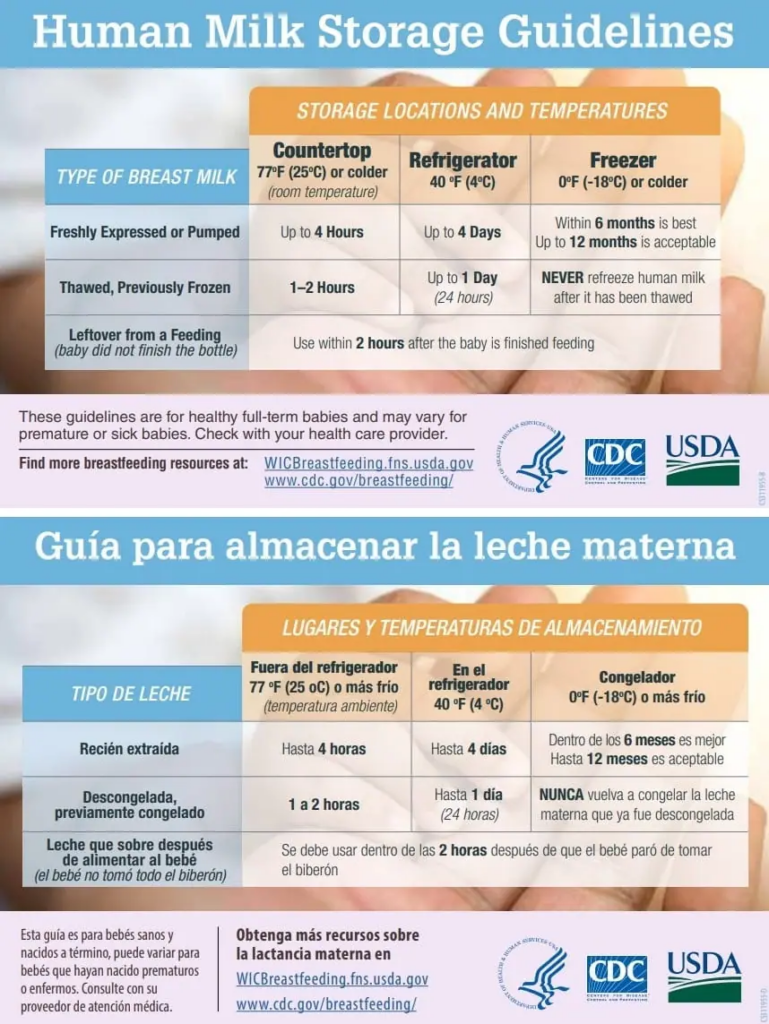
source : CDC.gov
Certaines bactéries présentes dans le lait maternel sont attendues
Oster a expliqué les faits en ce qui concerne les bactéries dans le lait maternel. Tout d'abord, il y aura toujours des bactéries dans le lait maternel, même le plus frais. Cela s'explique par le fait que la peau du sein de la mère est porteuse de bactéries. Deuxièmement, il y aura des bactéries supplémentaires provenant de la bouche du bébé si celui-ci commence un biberon et le termine lors d'une deuxième tétée. C'est pourquoi les CDC déconseillent de garder le reste pour plus tard. Troisièmement, les bactéries se multiplient plus rapidement à des températures plus élevées.
Mais, a observé M. Oster, “il est important de noter que les niveaux [de bactéries] importent ici. Il y a des bactéries partout et dans tout, même de mauvaises bactéries. À faible niveau, cela ne pose pas de problème. À des niveaux élevés, en revanche, il faut être prudent, et il existe des lignes directrices concernant le niveau de ces bactéries avant qu'elles ne posent un problème.”
Nous savons instinctivement que plusieurs jours passés sur le comptoir altèrent le lait, et qu'une heure à température ambiante (généralement considérée comme 77°F) ne pose pas de problème. Qu'est-ce que les données nous apprennent sur la période intermédiaire ? Oster a analysé ce que nous savons et ne savons pas encore sur la conservation sûre du lait maternel.
Le lait maternel sur le comptoir : Combien de temps est trop long ?
Nous le savons depuis 30 ans (grâce à cette petite étude de 1996) que le lait maternel fraîchement tiré est sûr bien plus longtemps que les quatre heures à température ambiante suggérées par le CDC [2]. Dans l'étude, le lait conservé sur le comptoir dans une pièce à 59°F ne présentait pas de croissance bactérienne significative, même 24 heures plus tard. La croissance est restée faible jusqu'à 8 heures sur le comptoir dans une pièce à 77°F. Même dans une pièce à 100°F, le lait a présenté une croissance bactérienne insignifiante pendant 4 heures sur le comptoir.
Dans l'étude, le lait conservé sur le comptoir dans une pièce à 59°F ne présentait pas de croissance bactérienne significative, même 24 heures plus tard. La croissance est restée faible jusqu'à 8 heures sur le comptoir dans une pièce à 77°F. Même dans une pièce à 100°F, le lait a présenté une croissance bactérienne insignifiante pendant 4 heures sur le comptoir.
A étude plus récente, également de faible ampleur, réalisée en 2013 du Nigeria ont obtenu des résultats comparables [3]. Le lait maternel a présenté une croissance bactérienne non préoccupante pendant 9 heures dans des conditions tropicales.
En outre, le 2026 preprint (pas encore évalué par les pairs) Étude allemande mentionnée ci-dessus a montré que la croissance bactérienne du lait maternel restait inchangée pendant 24 heures à la température du réfrigérateur. et à température ambiante [1]. Ce qu'en retient Oster ? “Cela signifie que si vous laissez accidentellement du lait pompé sur le comptoir pendant la nuit, vous n'aurez peut-être pas besoin de le jeter.”
Le lait maternel réchauffé peut être remis au réfrigérateur et vous pouvez mélanger du lait froid et du lait chaud.
Rappelons que les CDC déconseillent de conserver du lait qui a été réchauffé et qui n'a pas été utilisé du tout. Il en va de même pour le lait qui a été partiellement bu et qui n'a pas été terminé dans les deux heures. De même, le lait fraîchement pompé et encore chaud n'est pas censé être ajouté à un pichet, une bouteille ou un sac de stockage de lait froid dans le réfrigérateur. Le problème dans ces cas, comme toujours, est que le lait réchauffé ou plus chaud entraînera une croissance bactérienne plus rapide dans l'ensemble de l'échantillon.
Référence au lait décongelé et réchauffé mais n'était pas ivre Pour ce qui est du retour au réfrigérateur, Oster ajoute : “Les bactéries se développeraient un peu plus rapidement pendant la période de chauffage et ralentiraient ensuite dans le réfrigérateur. Dans l'ensemble, le temps de conservation serait similaire à ce qu'il serait si le produit était conservé au réfrigérateur, peut-être un peu plus court.”
En ce qui concerne le lait partiellement consommé, Oster fait le lien en citant tout d'abord une étude de la Commission européenne sur le lait partiellement consommé. ancienne étude la découverte que le lait maternel est moins sensible à la croissance bactérienne que le lait maternisé, et la combinaison de cette information avec la connaissance que le lait maternel est moins sensible à la croissance bactérienne que le lait maternisé. le lait maternisé partiellement alcoolisé est sans danger jusqu'à 24 heures plus tard [4] [5]. Les étude pré-imprimée ont constaté que même 24 heures plus tard, la croissance bactérienne dans le lait maternel partiellement bu n'était pas inquiétante [1].
En ce qui concerne le lait partiellement consommé, Oster relie les points en citant d'abord une ancienne étude montrant que le lait maternel est moins sensible à la croissance bactérienne que le lait maternisé, et en associant cette information au fait que le lait maternisé partiellement consommé est sans danger jusqu'à 24 heures plus tard. L'étude pré-imprimée a montré que même 24 heures plus tard, la croissance bactérienne dans le lait maternel partiellement bu n'était pas préoccupante.
En ce qui concerne le mélange de lait chaud fraîchement pompé avec du lait froid dans le réfrigérateur, Oster écrit : “nous avons établi plus haut que, généralement, le lait maternel est assez stable et que son stockage, même à température ambiante, est sûr pendant une période assez longue. Ajouter du lait maternel à un biberon, c'est-à-dire le réchauffer légèrement pendant une brève période tout en le laissant au réfrigérateur, constitue un changement très minime”.”
Nous ne savons pas si le lait maternel peut être conservé plus de quatre jours au réfrigérateur.
Oster observe que recherche disponible montre que le lait maternel non utilisé peut être conservé au réfrigérateur jusqu'à quatre jours [6]. C'est la limite autorisée par les directives du CDC, si le lait n'a pas encore été réchauffé. Au-delà du quatrième jour, nous ne disposons pas encore de données, selon Oster. Les recherches futures devront définir la limite exacte de la sécurité du lait maternel. La solution ? Congeler le lait si vous ne pensez pas l'utiliser dans les quatre jours.
Le bilan
Avec des exemptions pour les bébés nés avant terme, les bébés en soins intensifs néonatals et les bébés recevant du lait de donneuses, Oster pense que pour les bébés nés à terme et en bonne santé, les directives de conservation du lait maternel pourraient être assouplies en toute sécurité :
Avant le biberon est entamé, le lait maternel tiré peut rester sur le comptoir jusqu'à 8 heures et au réfrigérateur jusqu'à 4 jours.
Après le biberon a été entamé, le lait maternel tiré peut être conservé sur le comptoir pendant 8 heures et au réfrigérateur pendant 24 heures.
Bien que les recommandations du CDC n'aient pas changé, les travaux d'Oster donnent des pistes de réflexion aux mères qui se demandent continuellement si leur lait est sans danger pour leur bébé. L'allaitement est souvent comparé à un travail à temps plein, qui demande beaucoup de temps et d'énergie aux mamans. Et pour les nombreuses mamans qui doivent pomper, les tâches supplémentaires liées à la propreté de l'équipement et à la manipulation et au stockage corrects du lait alourdissent encore la charge de travail. Si les recommandations moins strictes d'Oster étaient adoptées, de nombreuses mamans s'en réjouiraient.
Références
[1] Anna Zychlinsky Scharff, Ludwig Sedlacek, Ariana de Oliveira Mekonnen, Ioannis Liolios, Simon Ritter, Franziska Fuchs, Christine Happle. Restes de lait infantile après l'alimentation au biberon : Parental Practices and Microbiological Findings. medRxiv 2026.02.13.26346179 ; doi : https://doi.org/10.64898/2026.02.13.26346179
[2] Hamosh M, Ellis LA, Pollock DR, Henderson TR, Hamosh P. Breastfeeding and the working mother : effect of time and temperature of short-term storage on proteolysis, lipolysis, and bacterial growth in milk. Pediatrics. 1996 Apr;97(4):492-8. PMID : 8632934.
[3] Ukegbu, P., Uwaegbute, A., Ijeh, I., & Ukegbu, A. (2013). Bacterial Load in Expressed and Stored Breast Milk of Lactating Mothers in Abia State, Nigeria (Charge bactérienne dans le lait maternel exprimé et stocké des mères allaitantes dans l'État d'Abia, au Nigeria). Revue africaine de l'alimentation, de l'agriculture, de la nutrition et du développement, 13(4), 8139-8154. https://doi.org/10.18697/ajfand.59.12640
[4] Hernandez J, Lemons P, Lemons J, Todd J. Effect of storage processes on the bacterial growth-inhibiting activity of human breast milk. Pediatrics. 1979 Apr;63(4):597-601. PMID : 375180.
[5] Wakui A, Sano H, Kawachi M, Aida A, Takenaka Y, Yonezawa A, Nakahata N, Moriyama S, Nishikata M, Washio J, Abiko Y, Mayanagi G, Yamaki K, Sakashita R, Tanaka K, Takahashi N, Sato T. Bacterial concentration and composition in liquid baby formula and a baby drink consumed with an artificial nipple. J Oral Biosci. 2021 Jun;63(2):161-168. doi : 10.1016/j.job.2021.03.001. Epub 2021 Mar 17. PMID : 33744408.
[6] Peters MD, McArthur A, Munn Z. Safe management of expressed breast milk : A systematic review. Women Birth. 2016 Dec;29(6):473-481. doi : 10.1016/j.wombi.2016.05.007. Epub 2016 Jun 16. PMID : 27318564.


Je pense qu'il convient de recommander The Leache League USA, dont les informations sont plus complètes que celles du CDC.
En Espagne, il est recommandé de donner le lait à la petite cuillère et non au mamelon, de cette façon le bébé se souvient uniquement du sein.