


Depression is sadly common among both pregnant and postpartum moms, but add-on light therapy could boost treatment effectiveness, a small 2025 Italian study found [1].
Perinatal depression is disturbingly common
‘Postpartum depression’ is the top predictive text search term for ‘postpartum ____,’ and it’s searched over 930,000 times per month. What’s more, an estimated 50% of postpartum depression cases begin while the woman is still pregnant. A 2023 systematic review of research from low-, middle- and high-income countries found that perinatal depression (meaning depression occurring during pregnancy or postpartum) affected an astounding 1 in 4 (24.7%) women [2].
Standard treatment for perinatal depression includes antidepressants and/or psychotherapy
For decades now, restorative reproductive medicine-trained practitioners have reported success in treating some postpartum depression cases with injections de progestérone. Additionally, in 2023, the FDA approved neurosteroid zuranolone, the first postpartum depression pill. Limited research also suggests some l'efficacité of supplementation with different vitamins or minerals. But these treatment modalities are still used by a minority of women with postpartum depression (and women actually receiving treatment for PPD are a tiny fraction of those suffering, research suggests).
At present, perinatal depression, whether during pregnancy or postpartum, is most often treated with one or the other (or a combination) of: a selective serotonin reuptake inhibitor (SSRI) antidepressant or psychotherapy (counseling), particularly la thérapie cognitivo-comportementale (CBT). Chief among the SSRIs for pregnancy and postpartum prescribing is sertraline, better known by its brand name Zoloft.
Though widely accessible and affordable, antidepressants take an average of four to six weeks to work and can cause les effets secondaires ranging from annoying to serious. Additionally, many pregnant and breastfeeding mothers are reluctant to take them because of concerns about impacts on babies in utero or via breastmilk. Additionally, while other depression symptoms may improve on SSRIs, sleep disturbances may remain or worsen. On the other hand, counseling can be cost prohibitive and relatively few therapists specialize in perinatal mental health. (See more about the safety of taking SSRIs during pregnancy in our recent series).
What’s so special about light therapy?
Light therapy, also known as bright light therapy (pas les mêmes comme thérapie par la lumière rouge), isn’t just another possibly helpful treatment option among many. Because of its beneficial impacts on sleep quality in particular, and the known connection between sleep disturbance and depressive symptoms—especially during pregnancy—it may actually be “the best man for the job” of alleviating perinatal depression [3].
How it works
Originally developed and studied for the treatment of seasonal affective disorder, researchers have subsequently explored light therapy’s helpfulness in treating major depressive disorder and, most recently, perinatal depression.
According to the Italian study, light exposure specifically stimulates the retinal ganglion cells (cells in the retina of the eye). These, in turn, impact two key parts of the brain. First up is the suprachiasmatic nucleus in the hypothalamus, which is the mission control center for the brain’s circadian clock. Light exposure also affects the lateral habenula, also known as the brain’s ‘antireward center.’ Though most people have never heard of the lateral habenula, it is increasingly attracting research attention to clarify its role in major depressive disorder and other psychiatric disorders.
The study authors notée, “By regulating circadian rhythms, light therapy exerts antidepressant effects through multiple mechanisms, including modulation of hormone secretion and serotonergic pathways, ultimately enhancing energy levels, concentration, and attention.”
Study: Bright light therapy may be an effective add-on treatment for perinatal depression
The Italian study was quite small, comprising 15 total participants. Eight women were in the control group of standard treatment only, meaning either selective serotonin reuptake inhibitor (SSRI) antidepressant use or eight sessions of psychotherapy. The other seven women were in the intervention (i.e., light therapy) group.
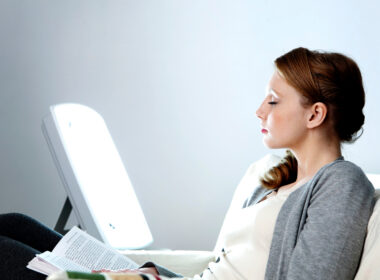
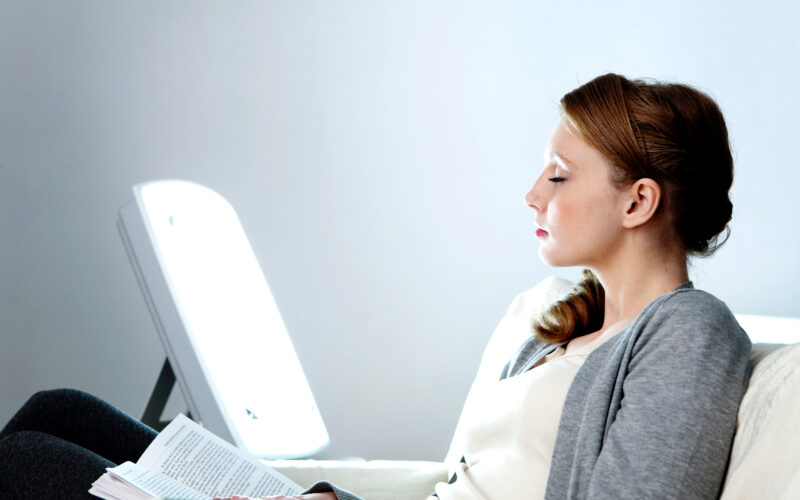
Participants in the intervention group held a bright light (10,000 lux) 15-20 inches away from the face, starting 30 minutes or less after waking up and lasting 30 minutes per day, every day for five weeks (there’s a handy chart for how that compares to daylight or sunlight ici). Light therapy was done in the comfort of each participant’s home, and was on top of standard treatment, meaning either psychotherapy or antidepressant use.
The intervention group of light therapy plus standard treatment was more effective at reducing depressive symptoms and improving sleep quality than standard treatment alone, and the benefits remained at a 7-month follow-up. Of note, aucun of the women in the light therapy group reported any of the anticipated potential side effects, including eye irritation or strain, headache, or nausea [1].
The intervention group of light therapy plus standard treatment was more effective at reducing depressive symptoms and improving sleep quality than standard treatment alone, and the benefits remained at a 7-month follow-up. Of note, aucun of the women in the light therapy group reported any of the anticipated potential side effects, including eye irritation or strain, headache, or nausea.
How does this compare with other research?
A 2023 meta-analysis of eight randomized controlled trials found that “light therapy had a significant mild‐to‐moderate effect on the improvement of depressive symptoms in perinatal women and a moderately significant effect on sleep disturbances compared to placebo/control treatment.” Control treatments in all but one of the studies were light therapy at <1,000 lux [4].
Il est intéressant de noter qu'un 2024 revue systématique et méta-analyse of six randomized controlled trials of bright light therapy (10,000 lux) for perinatal depression, found negligible improvement differences between bright light therapy and dim light therapy. (Though the review does not specify how many lux are considered dim light, this 2023 review of light therapy for insomnia classifies 40-400 lux as dim light). However, bright light therapy groups were more likely to maintain treatment benefits months later [5] [6].
However, the key takeaway from the 2024 review and meta-analysis might not be that bright light therapy is ineffective. Rather, if what’s true for cancer patients holds true for mothers with perinatal depression, à la fois dim light therapy and bright light therapy may be effective in improving sleep quality [7].
More research is needed
Future research is needed to prove light therapy’s effectiveness (or ineffectiveness) as a standalone treatment option for those who can’t afford therapy and don’t want to take medication. Larger sample sizes are also necessary to confirm the findings of the small studies done to date.
Le bilan
Bright light therapy is proven to be safe and can be done in the comfort of one’s own home. If you or someone you love is experiencing depression during pregnancy or postpartum, encourage them to discuss the possibility of adding light therapy to their treatment plan with their healthcare practitioner.
Références
[1] Bianciardi E, Sferra I, Castellani G, Pinci C, Marinucci E, Adulti I, Quinto RM, Niolu C. Light therapy as an add-on to standard care for perinatal depression: a 7-month follow-up randomized controlled study. Riv Psichiatr 2025;60(5):188-195. doi 10.1708/4583.45900
[2] Roddy Mitchell A, Gordon H, Lindquist A, Walker SP, Homer CSE, Middleton A, Cluver CA, Tong S, Hastie R. Prevalence of Perinatal Depression in Low- and Middle-Income Countries: A Systematic Review and Meta-analysis. JAMA Psychiatry. 2023 May 1;80(5):425-431. doi: 10.1001/jamapsychiatry.2023.0069. PMID: 36884232; PMCID: PMC9996459.
[3] Wołyńczyk-Gmaj D, Różańska-Walędziak A, Ziemka S, Ufnal M, Brzezicka A, Gmaj B, Januszko P, Fudalej S, Czajkowski K, Wojnar M. Insomnia in Pregnancy Is Associated With Depressive Symptoms and Eating at Night. J Clin Sleep Med. 2017 Oct 15;13(10):1171-1176. doi: 10.5664/jcsm.6764. PMID: 28859715; PMCID: PMC5612632.
[4] Li X, Fang L, Guan L, Zhang J, Zheng M, Zhu D. The effects of light therapy on depression and sleep in women during pregnancy or the postpartum period: A systematic review and meta-analysis. Brain Behav. 2023 Dec;13(12):e3339. doi: 10.1002/brb3.3339. Epub 2023 Nov 29. PMID: 38031199; PMCID: PMC10726786.
[5] Chen Y, Zhao J, Wang J, Peng L, Cai Z, Zou Z, Chen X. Effect of Bright Light Therapy on Perinatal Depression: A Systematic Review and Meta-Analysis: Effet de la luminothérapie sur la dépression périnatale: une revue systématique et une méta-analyse. Can J Psychiatry. 2024 Oct;69(10):737-748. doi: 10.1177/07067437241248051. Epub 2024 Jun 11. PMID: 38863243; PMCID: PMC11485670.
[6] Chambe, J., Reynaud, E., Maruani, J., Fraih, E., Geoffroy, P. A., & Bourgin, P. (2023). Light therapy in insomnia disorder: A systematic review and meta-analysis. Journal of Sleep Research, 32(6), e13895. https://doi.org/10.1111/jsr.13895
[7] Horng-Shiuann Wu, Meghana Atmakur, Jessica Sender, Meng-Hua Tao, Jiying Ling, 0436 Is Bright Light More Effective Than Dim Light in Improving Sleep Among Individuals with Cancer? A Meta-Analysis, Sleep, Volume 49, Issue Supplement_1, May 2026, Page A194, https://doi.org/10.1093/sleep/zsag091.0436