


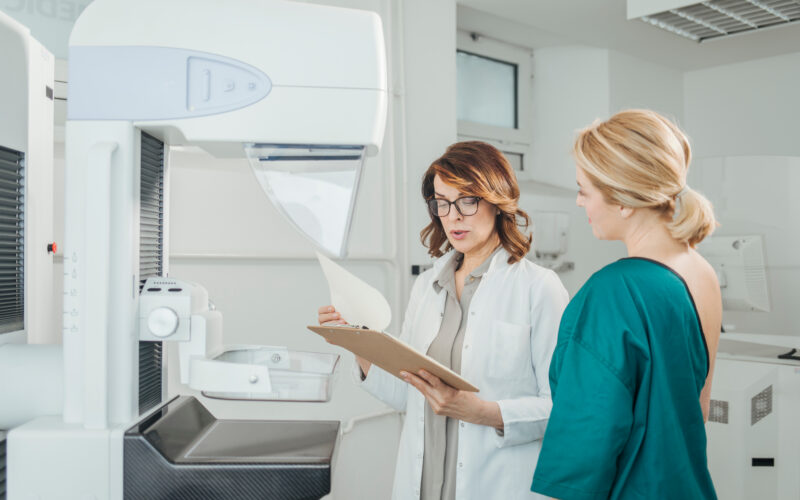
You’ve heard the message so often it feels unquestionable: Get your mammogram! Since early detection of breast cancer saves lives, it’s just common sense. But what if the story we’ve been told about breast cancer screening is more complicated than that? What if the test widely promoted as a lifesaver comes with real limitations and tradeoffs, some of which are rarely discussed during a routine annual visit?
This isn’t about telling women what they debe o no debería do. The ultimate decision regarding screening belongs to each woman in conversation with a trusted healthcare professional, but making an informed decision about mammograms goes beyond the slogans we’ve all heard. It requires understanding both benefits y harms, especially when those harms are not trivial.
Keep in mind that this article touches on the negatives of mammogram testing, but with the intention of educating the reader on the potential side effects and risks, which aren’t always as well discussed as the potential benefits. When it comes to mammography, the reality is more nuanced than what the pink ribbons suggest.
The uncomfortable truth about mammogram accuracy
Let’s begin with a fact that surprises many women: mammograms are imperfect screening tools.
Large, long-term studies show that about half of women who undergo annual mammograms for ten years will receive at least one false-positive result—that is, an abnormal finding that turns out not to be cancer [1]. With biennial (every other year) screening, the false-positive risk is lower, but still significant.
A false positive isn’t just a statistical inconvenience. It can mean weeks or months of anxiety, additional imaging, repeat appointments, and sometimes even unnecessary biopsies. In other words, this kind of error carries its own physical and emotional burdens that are worth considering.
Research from the Breast Cancer Surveillance Consortium and the National Cancer Institute has also found that women who experience false positives requiring short-interval follow-up imaging are less likely to return for future screenings. In one large cohort, about 61% returned for routine screening, compared with 77% of women who had normal results [1]. A system designed to promote early detection may, paradoxically, discourage continued participation.
False positives are especially common among younger women and women with dense breasts [1]. These groups are often encouraged to screen most aggressively. For some women, the process of confirming that an abnormal finding is benign can stretch on for a year or more. While the issue is often corrected in time, the emotional and practical impact of it is still worth considering.
The overdiagnosis problem
More difficult and more controversial, is the issue of overdiagnosis.
Overdiagnosis refers to cancers detected through screening that would never have caused symptoms or shortened a woman’s life if they had remained undiscovered. Because there is currently no reliable way to distinguish harmless tumors from dangerous ones, nearly all detected cancers are treated.
Estimates of overdiagnosis vary depending on methodology, but many peer-reviewed analyses place the rate around 10–20% [2]. A 2022 analysis affiliated with Duke University estimated that roughly 15% of screen-detected breast cancers in the United States represent overdiagnosis [2].
For older women, particularly those over 70, the proportion may be higher. A 2023 study published in Annals of Internal Medicine encontrado that as life expectancy decreases, the likelihood that a detected cancer would never become clinically relevant rises substantially [3]. It is still up to the patient to decide if they want this information or in what cases it would be the most relevant, since this new information naturally opens a whole new can of worms.
This matters because treatment is not benign. Surgery, radiation, and chemotherapy can cause lasting physical harm, secondary cancers, cardiovascular disease, and significant psychological distress. Women labeled “cancer survivors” may spend years managing the fallout of treatment for a disease that possibly never would have affected their health or longevity.
None of this means breast cancer isn’t real or dangerous—it is. But it does mean that early detection is not synonymous with benefit in every case, especially when detection outpaces our ability to predict which cancers truly require intervention.
None of this means breast cancer isn’t real or dangerous—it is. But it does mean that early detection is not synonymous with benefit in every case, especially when detection outpaces our ability to predict which cancers truly require intervention.
Radiation exposure: Small doses, real questions
Mammography uses low-dose X-ray radiation. For a single exam, the dose is considered small. It is roughly equivalent to several weeks of natural background radiation, and most professional organizations conclude that the benefits outweigh the risks for many women [4].
However, radiation exposure is cumulative. A modeling study published in Annals of Internal Medicine found that lifetime risk from mammography-related radiation increases with earlier and more frequent screening, particularly for women with larger breasts, who often require higher doses to obtain clear images [4]. The same research suggested that biennial screening starting later in life significantly reduces radiation-associated risk while preserving most of the mortality benefit seen with screening [4].
These risks are still considered small, but they are not zero. And they are rarely discussed when women are urged to begin annual screening at a young age and continue indefinitely. This is particularly relevant for women with hypochondriatic tendencies, who may feel inclined to over-test and gather as much information as they can, without regard for the implications and burden of testing.
The dense breast dilemma
Nearly half of all women have dense breast tissue, which both increases breast cancer risk and makes mammograms less effective. On a mammogram, dense tissue and tumors appear similarly white, which makes detection more difficult. As one Fred Hutchinson Cancer Center researcher memorably noted, it can be like “looking for a polar bear in a snowstorm.”
In its 2024 guidelines, the U.S. Preventive Services Task Force reconocido that there is insufficient evidence to recommend for or against supplemental screening—such as ultrasound or MRI—for women with dense breasts. In other words, for a large percentage of women, the primary screening tool is known to be limited, and consensus on better alternatives is still evolving.
In its 2024 guidelines, the U.S. Preventive Services Task Force acknowledged that there is insufficient evidence to recommend for or against supplemental screening—such as ultrasound or MRI—for women with dense breasts. In other words, for a large percentage of women, the primary screening tool is known to be limited, and consensus on better alternatives is still evolving.
Yet dense-breasted women are often told simply that their mammogram was “normal,” without clarification about how much confidence that result deserves.
Are there alternatives to mammograms?
No screening method is perfect, but several tools may be appropriate in specific contexts.
Breast Ultrasound
Ecografía uses sound waves rather than radiation and can detect some cancers missed by mammography in dense tissue. However, it also increases false positives and is generally recommended as a supplemental instead of a standalone tool.
Breast MRI
MRI is the most sensitive imaging modality and is not affected by breast density. It does not use radiation, but it is expensive, time-intensive, and prone to false positives. Current guidelines typically reserve MRI for women at high risk due to genetic mutations or strong family history [5].
Contrast-Enhanced Mammography (CEM)
CEM combines mammography with an iodine-based contrast agent. Emerging research sugiere that CEM may approach MRI-level sensitivity at lower cost and greater convenience, with promising results in clinical trials. However, it has not yet been incorporated into most national screening guidelines.
3D Mammography (Tomosynthesis)
Tomosynthesis creates layered images of the breast and has been shown to modestly improve cancer detection while reducing recall rates. It is now widely available and covered by many insurers.
Thermography
Thermography is often marketed as a radiation-free alternative, but the FDA has repeatedly warned that it is not a replacement for mammography. It is cleared only as an adjunctive tool and cannot reliably detect early-stage cancers.
Practical breast cancer screening guidance for women
Know Your Personal Risk
Family history, genetics, prior radiation exposure, breast density, and previous biopsies all matter. Screening should not be one-size-fits-all.
Understand Guideline Differences
As of 2024, the USPSTF recommends biennial screening from ages 40 to 74 for average-risk women. Other organizations recomiende different schedules, reflecting real scientific uncertainty.
Ask About Breast Density
Si tiene dense breasts, ask what that means for the reliability of your mammogram and whether supplemental imaging makes sense for you.
Consider Screening Frequency Thoughtfully
For many average-risk women, biennial screening offers a better balance of benefit and risks than annual exams [4].
Practice Breast Awareness
While routine self-exams are no longer emphasized, they are still the basics and the lowest risk option. Taking a few minutes to evaluate your own breasts and promptly reporting changes remains important.
Be Wary of Absolutes
Any screening test presented as flawless or as a moral obligation rather than a medical choice deserves scrutiny.
The bottom line on mammograms and breast cancer screening
Mammography has undoubtedly contributed to declines in breast cancer mortality and early detection can save lives. Those facts are real and worth knowing; but so are the realities of false positives, overdiagnosis, radiation exposure, and the (at times) unnecessary burden that comes with uncertainty. Especially for women in certain age ranges and those with dense breasts, it is important to take some time to further consider the implications with the particular treatment and screening. If there’s one thing that applies to all, it’s that testing must be approached with prudence and overdoing it may cause more harm than help.
A 2024 JAMA editorial noted that many women who die of breast cancer would have done so regardless of screening, underscoring that early detection, while valuable, is not a guarantee [4]. Perhaps as with many medical conundrums, these screenings touch people in a unique way. They bring a sense of responsibility, care, and good intentions while also forcing us to face our fears, including the lack of control and our own mortality. Regardless of the particular approach taken by a patient and her doctor and its outcome, women deserve honesty, not fear-based messaging. Informed consent means understanding limits as well as benefits.
Regardless of the particular approach taken by a patient and her doctor and its outcome, women deserve honesty, not fear-based messaging. Informed consent means understanding limits as well as benefits.
Your body is worthy of thoughtful and individualized care. Let’s not forget that we all have a right to ask hard questions before agreeing to any medical intervention. And while risks and side effects aren’t always avoidable, it is important that we take them on with informed consent.
Referencias
[1] Miglioretti DL, Abraham L, Sprague BL, Lee CI, Bissell MCS, Ho TH, Bowles EJA, Henderson LM, Hubbard RA, Tosteson ANA, Kerlikowske K. Association Between False-Positive Results and Return to Screening Mammography in the Breast Cancer Surveillance Consortium Cohort. Ann Intern Med. 2024 Oct;177(10):1297-1307. doi: 10.7326/M24-0123. Epub 2024 Sep 3. PMID: 39222505; PMCID: PMC11970968. [2] Ryser MD, Lange J, Inoue LYT, O’Meara ES, Gard C, Miglioretti DL, Bulliard JL, Brouwer AF, Hwang ES, Etzioni RB. Estimation of Breast Cancer Overdiagnosis in a U.S. Breast Screening Cohort. Ann Intern Med. 2022 Apr;175(4):471-478. doi: 10.7326/M21-3577. Epub 2022 Mar 1. PMID: 35226520; PMCID: PMC9359467. [3] Richman IB, Long JB, Soulos PR, Wang SY, Gross CP. Estimating Breast Cancer Overdiagnosis After Screening Mammography Among Older Women in the United States. Ann Intern Med. 2023 Sep;176(9):1172-1180. doi: 10.7326/M23-0133. Epub 2023 Aug 8. PMID: 37549389; PMCID: PMC10623662.[4] Miglioretti DL, Lange J, van den Broek JJ, Lee CI, van Ravesteyn NT, Ritley D, Kerlikowske K, Fenton JJ, Melnikow J, de Koning HJ, Hubbard RA. Radiation-Induced Breast Cancer Incidence and Mortality From Digital Mammography Screening: A Modeling Study. Ann Intern Med. 2016 Feb 16;164(4):205-14. doi: 10.7326/M15-1241. Epub 2016 Jan 12. PMID: 26756460; PMCID: PMC4878445.
[5] Federica Pediconi, Giuliana Moffa, Contrast-Enhanced Mammography: Bridging the research gaps and defining the future, European Journal of Radiology, Volume 192, 2025, 112351, ISSN 0720-048X, https://doi.org/10.1016/j.ejrad.2025.112351.