



Editor’s note: Natural Womanhood writer Мерло Фогарти recently attended the inaugural National Conference on Women’s Health in Washington, D.C., hosted by the Department of Health and Human Services. Below are her observations from the conference, as well as insights from conversations had in and around conference activities.
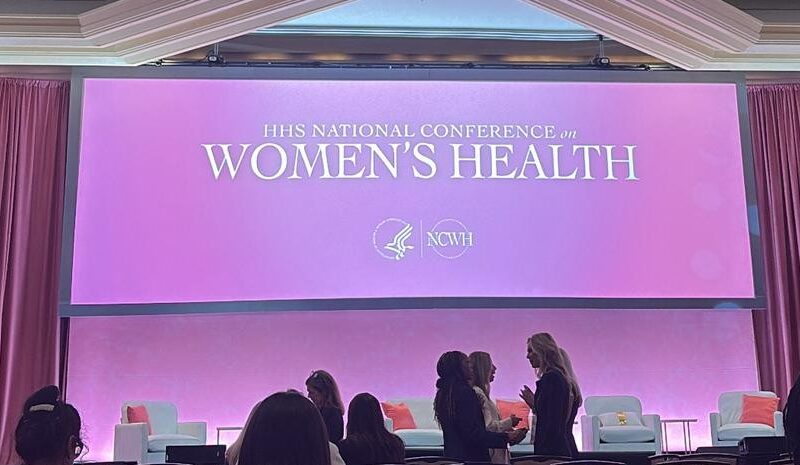
Last week, the Department of Health and Human Services (HHS) hosted the inaugural National Conference on Women’s Health (NCWH) in Washington, D.C.
Spanning over a period of three days, the conference covered a wide variety of women’s health issues, including maternal and infant health, mental health, Alzheimer’s, cancer, chronic disease, autoimmune conditions, hormonal replacement therapies (HRT), menopause, and fertility. Over 1,200 participants attended from across the country.
Динамики included several prominent women in the women’s health and fertility space, including Доктор Маргарита Дуэйн, Dr. Tamer Seckin, Dr. Suzanne Fenske, Dr. Dorothy Fink, Dr. Lynese Lawson, Dr. Andrea Salcedo, Dr. Marty Makary, and Dr. Jay Bhattacharya.
The first panel began with a discussion of the November 2025 decision by the FDA to remove the black box warning on hormone replacement therapies. The discussion focused primarily on the treatment of UTIs through vaginal estrogen, and the monumental step taken by the FDA in finally updating warning guidelines for something researchers have known to be safe for treatment.
The evening panel included a conversation between Stephanie Carlton, Deputy Administrator and Chief of Staff of CMS, and Heidi Overton, MD, PhD, Deputy Assistant to the President, White House Domestic Policy Council. Their conversation primarily focused on what different departments within HHS have accomplished so far in this administration, and how they believe the Make America Healthy Again (MAHA) initiative is changing the game for health across our nation.
Personalized healthcare that focuses on root causes
This general acknowledgment remained throughout the conference: that this administration is committed to addressing health differently than prior ones. Judy Lopez, Program Manager for the Richard and Helen DeVos Center for Human Flourishing at The Heritage Foundation, said the conference takeaways were clear: medical care going forward must be personalized and address root causes—no more one-size-fits-all approaches.
Judy Lopez, Program Manager for the Richard and Helen DeVos Center for Human Flourishing at The Heritage Foundation, said the conference takeaways were clear: medical care going forward must be personalized and address root causes—no more one-size-fits-all approaches.
Lopez helped organize a reception at Heritage’s office that brought together many speakers and leaders in the women’s health movement, including Dr. Dorothy Fink and the Heritage Foundation’s own Emma Waters.
Dr. Marguerite Duane, founder of ФАКТЫ о бесплодии, spoke on a panel called “Addressing Chronic Conditions in the Evaluation of Infertility,” alongside Asima Ahmad, Andrea Salcedo, and Tamer Seckin, with moderator Alexis Joel. Lopez called this one of the strongest sessions of the conference, with a constructive and forward-looking conversation and real-world applications for expanding access and improving education on fertility and восстановительная репродуктивная медицина.
Takeaways from mainstream media have pegged the conference as a “fertility education” and “birth control skepti[c]” summit, despite it spanning vast topics within women’s health. Notably, the conversation throughout the conference returned again and again to a bipartisan belief: historically, women’s health has received less funding, research, and attention, and this reality needs to change.
Notably, the conversation throughout the conference returned again and again to a bipartisan belief: historically, women’s health has received less funding, research, and attention, and this reality needs to change.
Healthcare for women at all stages
After the conference, Dr. Duane commented on the increased attention on women’s historical exclusion from federal drug trials. While almost every panel brought the same question to the table (“Why aren’t we redoing studies for these drugs that were never tested on women in the first place?”) Dr. Duane had another suggestion: Why aren’t these studies being done on naturally cycling women? The effects of hormonal birth control can skew the body’s reaction to certain medications; if the women in drug trial runs aren’t being separated according to their use of hormonal contraceptives, then the studies aren’t taking an accurate assessment of the effects on women’s naturally functioning physiology.
Other noteworthy panels included “Menopause, Hormone Health and Longevity,” and “Innovation in the Private Sector: The Next Decade in Women’s Health.” Dr. Sarah Hill, author of Мозг периода и Это ваш мозг о контроле рождаемости, was one of the many experts discussing hormone health, each offering answers to questions like why the primary literature doesn’t distinguish between different types of hormone therapies, and why doctors weren’t taught about caring for women in menopause in their medical education.
The latter panel brought together members of leading FemTech organizations such as Oura, Celmatix, and Gaia Health. Their discussion revolved primarily around носимые устройства, personalization, integrative platforms, and virtual platforms as the future of women’s healthcare.
Women’s health advocates on a national stage
A sentiment shared by several attendees was a lack of clarity over the conference’s goals—with some hypothesizing that perhaps the groundwork for the event was laid by the previous administration, and picked up by the “MAHA crowd” once the Trump administration began its term last January. The second lady, Usha Vance, made a surprise appearance, however, highlighting the priority this administration is giving to women’s health issues.
Overall, the conference reflects an exciting moment: authentic women’s health advocates are finally receiving attention on the national stage. Preventative and root-cause medicine has a voice at the highest levels of government, and investment into reproductive health seems to be a top priority. The work is only beginning, but the possibilities are endless as long as patients, advocates, and experts continue fighting for the holistic, pro-woman approach to healthcare that all women deserve.