



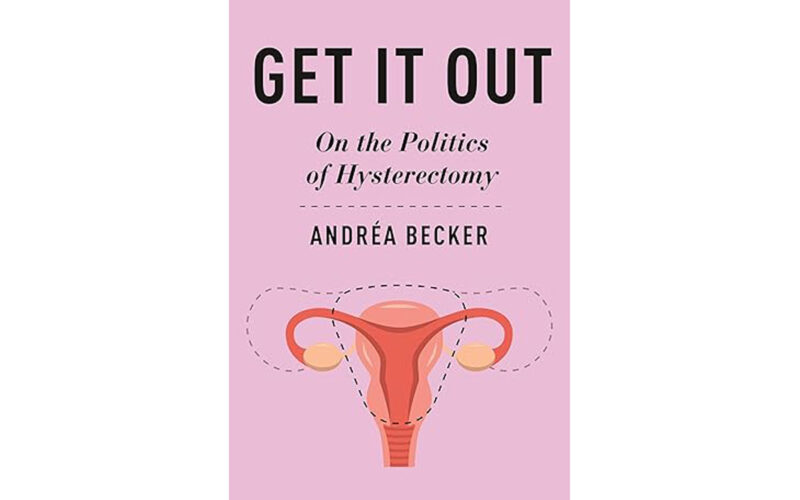
“This book is dedicated to the uterus—a misunderstood organ, an organ dubbed ‘the origin of all disease’ in Hippocratic texts, the organ we all once called home” (Becker vii).
"Hysterectomy” and “hysteria” share the root word hystera, meaning womb or uterus-truly one of the most misunderstood organs of all time. Even today, with all our technology and medical advancements, we do not fully understand the workings of the uterus or the female reproductive system as a whole. It is because of these misunderstandings that psychological disturbances that supposedly characterized hysteria were considered directly linked to the uterus—thus, marking part of hysterectomy’s dark and often political history.
This was the political history I was hoping to read about when I picked up Andréa Becker’s book Get It Out: On the Politics of Hysterectomy. While Becker does venture into that historical territory in a few brief instances, her primary focus was the modern woman’s (or “person with a uterus,” as she says) access to hysterectomy and how social and political influences either gatekeep the procedure or pressure women into it.
Read to the end of this Get It Out book review to see whether I’ve casted my vote for buying, borrowing, or passing.
Andréa Becker is an assistant professor of sociology. She has written for The New York Times, The Nation, и Slate on the topics of gender, culture, and race and how these things influence reproduction. Becker’s postdoctoral research was in the Advancing New Standards in Reproductive Health program, giving her specific insight into this topic. Because of this, Becker is very qualified to speak into the social and cultural aspects of reproductive health, but, as is demonstrated in the book, her medical credibility is lacking.
Кто является целевой аудиторией Get It Out?
As I read the book, I quickly discovered that there are a few specific groups for whom Get It Out is intended. Generally, the book purports to be written for anyone (but especially for women) who wants to understand the multiple nuances of getting a hysterectomy and why, from a social standpoint, it can be difficult to access. However, as I read the book, I recognized that the author was primarily passionate about the goals of the LGBTQ+ community, and it became clear that she wrote the book with this group of individuals in mind. However, the book also highlights hysterectomy access for women of color versus white women, and it discusses the perspective of women with chronic reproductive illnesses like endometriosis.
Каковы основные области содержания Get It Out?
Get It Out is broken up into five chapters. The first focuses on the history of hysterectomy. The second discusses why a person would want to have a hysterectomy. The third chapter talks about the dynamics of being able to choose a hysterectomy. In the fourth chapter, Becker explores how people feel about their hysterectomies. Finally, Becker looks into how accessible a hysterectomy is for different groups of people. The content of Get It Out focuses on the personal testimonies of the participants of Becker’s social analysis on hysterectomy.
Сильные стороны Get It Out
Get It Out is a unique book in that Becker primarily uses anecdotes from other women who have either had or been denied a hysterectomy to make her argument, which is chiefly that hysterectomy should be more widely available, and women should have the right to choose the procedure. The book is also unique in that Becker is not a medical professional, so she is not approaching this topic from a health standpoint. Her main goal in writing the book was to highlight how political and social dynamics impact a woman’s ability to have a hysterectomy. This book also makes a strong point that the narrative of hysterectomy as something to mourn is not entirely true, and many women are thankful to have received the procedure.
Get It Out is a unique book in that Becker primarily uses anecdotes from other women who have either had or been denied a hysterectomy to make her argument, which is chiefly that hysterectomy should be more widely available, and women should have the right to choose the procedure.
Ограничения или "слепые пятна
Unfortunately, there were many limitations and blind spots in Get It Out. Probably the most significant was the small sample size. Becker interviewed 100 people, which is no small feat, but it is not large enough to be representative of the general population. Additionally, her participants were not selected randomly. Becker targeted certain groups to collect her data, and almost 50% of her participants were from the LGBTQ+ community. This, again, makes her analysis biased and not representative of the general population.
Another major limitation is Becker’s demonstrated lack of knowledge in the reproductive sphere. On page 3 of Get It Out, Becker talks about the trials of family planning. She says avoiding pregnancy is “demanding, thankless work that occupies thirty consecutive years on average, ranging from a tedious daily pill to the dreadful placing of an intrauterine device (IUD)” (pg. 3). If you are a regular reader of Natural Womanhood, you know that Becker is missing an entire genre of ways to avoid pregnancy found in Информированность о бесплодии or Natural Family Planning methods. It is worth noting that these are never mentioned in the book.
Becker also presents hysterectomy as the end-all, be-all treatment for issues like ПМДР и эндометриоз. Endometriosis is discussed on multiple occasions, but only on a few brief occasions is laparoscopic surgery (the true gold-standard treatment of endometriosis) brought up. When it is mentioned, it is done in a seemingly dismissive manner. This shows a lack of understanding of the definition of endometriosis as a disease characterized by tissue similar to the endometrium growing within и outside of the uterus, not a disease that stays contained within the uterus.
Becker also demonstrates a lack of understanding of the scientific definition of abortion and reproduction in general. On page 5, she says, “If the idea of terminating a single pregnancy incites such moral panic, I thought, what might it mean to willingly preclude the option of pregnancy by excising the uterus altogether?” (Becker 5). This is only one of many instances where Becker presents hysterectomy as a procedure that is similar to abortion, and shows a lack of research on social groups who disagree with her views. Additionally, Becker claims that one can simply preserve their fertility by freezing their eggs to use later through a surrogate (pg. 13). Although this is a choice someone could make, by definition, this is not preserving the natural function of fertility.
Потому что Get It Out is intended to be an analysis of the social and cultural influences on hysterectomy access, the author does not make any true suggestions for the average woman. She makes little mention of the potential serious complications of hysterectomy, nor questions whether too many are being performed in the United States. The book also has a heavy focus on nuanced topics such as hysterectomy for “trans healthcare.” Additionally, Becker’s understanding of true fertility treatment is limited and biased. Get It Out focuses entirely on hysterectomy as the treatment for all of the concerns of the groups of women mentioned. (It is worth noting that that is the goal of the book. The book is not intended to be a source for all fertility treatment options.) That being said, these factors mean the book probably isn’t the best resource for someone searching to determine if a hysterectomy is the right treatment for her.
Вердикт: купить, одолжить или пропустить Get It Out совсем?
Get It Out gets a skip from me. In fact, I found myself highlighting and noting false or misguided statements throughout the book. I found it particularly problematic that Becker would often present only a fragment of the full picture of options for women when it came to the reasons they would want a hysterectomy.
Additionally, I was thrown off guard by some of the content of the book. I did expect there to be content about hysterectomy as a part of trans healthcare. However, I had hoped that a book claiming to represent the general political history of hysterectomy would focus more on the history of hysteria, reproductive illnesses, and even the ableist and racist legacy of the procedure (the latter of which, to give Becker credit, she does discuss in detail). I was very disappointed in her lack of definitions and her emotionally-driven writing. There was also quite a bit of fear-mongering throughout the book, and reliance upon celebrity stories that may mislead readers about the purported benefits of the procedure for issues like endometriosis.
Ultimately, because of the extreme biases of the author, I would not recommend Get It Out as a helpful read for someone weighing the pros and cons of a hysterectomy, or even for someone simply wanting to understand the legacy of the procedure. A more reliable and less-biased resource would be better—but someone else may need to write it first!